Introduction
A Mango Banana Smoothie is quite possibly the creamiest, most naturally sweet smoothie you’ll ever make—a thick, velvety blend where ripe bananas and tropical mangoes come together in perfect harmony, creating something that tastes more like a milkshake or soft-serve ice cream than a “health drink,” yet it’s made with nothing but whole fruit and simple ingredients. This isn’t just another generic fruit smoothie; it’s a carefully balanced combination where bananas provide unmatched creaminess and subtle sweetness.
I’ll never forget the first time I truly appreciated this combination. I was visiting a beachside café in Hawaii where they served fresh smoothies made from local fruit. When I ordered what they called their “sunrise smoothie,” I expected the typical thin, icy fruit blend I’d gotten used to from chain smoothie shops.
That revelation changed how I thought about smoothies entirely. I realized that with the right ingredients and proper technique, you don’t need protein powders, sweeteners, or a dozen different add-ins to make something absolutely delicious. Sometimes the simplest combinations are the most perfect, and mango with banana is one of nature’s.
Since returning from that trip, I’ve made this Mango Banana Smoothie hundreds of times, perfecting the ratios, testing different variations, and serving it to countless friends, family members, and skeptical smoothie-doubters who all had the same reaction:
What makes this smoothie exceptional is its versatility and approachability. It’s naturally vegan and dairy-free (though you can add yogurt if you prefer), requires just four basic ingredients, takes three minutes from start to finish, and appeals to absolutely everyone—from toddlers to picky eaters to health-conscious adults.
Whether you’re new to smoothie-making or a seasoned blender enthusiast, this Mango Banana Smoothie will become your go-to recipe for mornings when you need something quick, satisfying, and genuinely delicious.
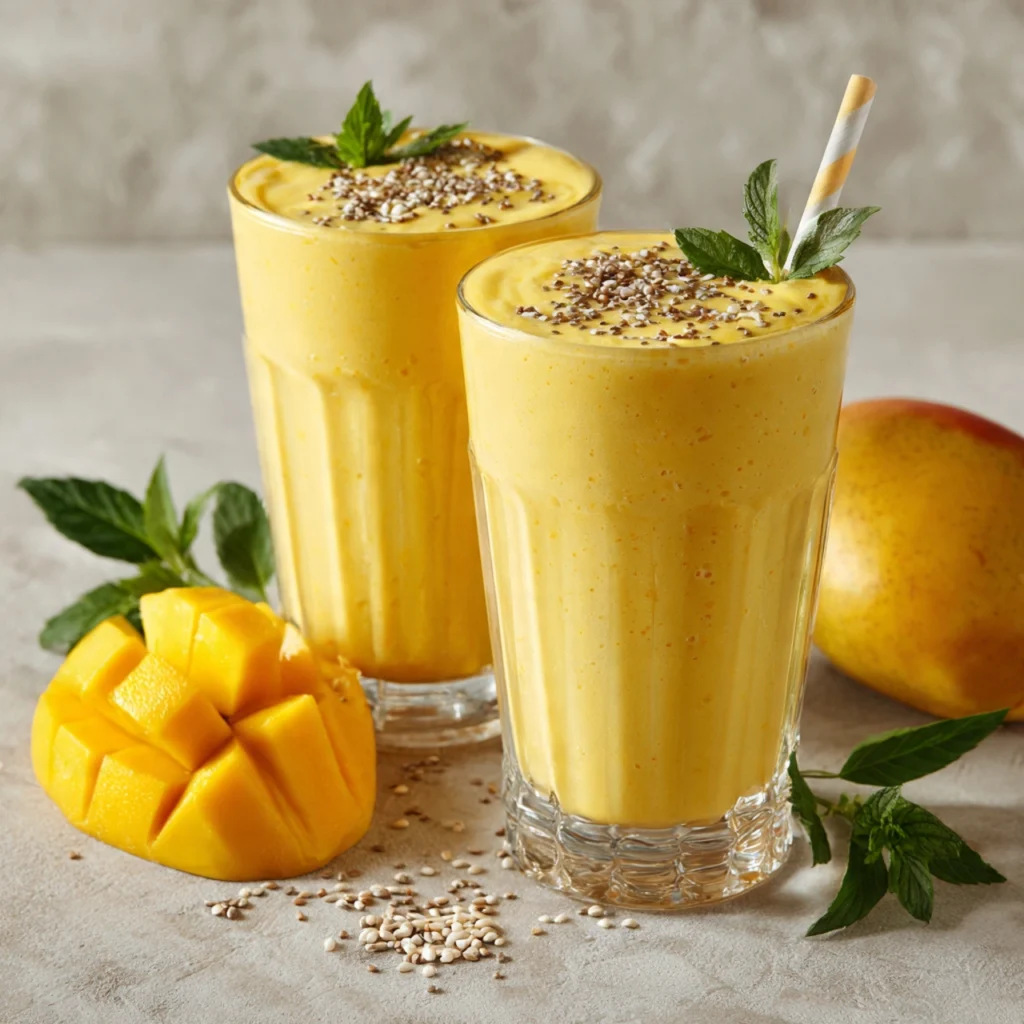
Ingredients For Mango Banana Smoothie
For the Classic Mango Banana Smoothie:
- 1 large ripe banana (fresh or preferably frozen, about 120g) – provides incredible creaminess and natural sweetness
- 1 cup ripe mango chunks (fresh or frozen, about 150g) – adds tropical flavor and gorgeous color
- ½ cup milk (dairy or non-dairy) – creates drinkable consistency; adjust based on desired thickness
- ½ cup ice cubes (about 4-5 cubes; omit if using frozen banana and frozen mango)
- Optional: 1-2 teaspoons honey or maple syrup (only if fruit isn’t sweet enough)
Optional Flavor Enhancers:
- ½ cup plain Greek yogurt – adds tanginess, protein, and extra creaminess
- ¼ cup orange juice – enhances tropical flavor and adds vitamin C
- 1 tablespoon chia seeds – boosts omega-3s and fiber
- 1 scoop vanilla protein powder – transforms it into high-protein breakfast
- ¼ teaspoon vanilla extract – adds warmth and depth
- 1 tablespoon coconut flakes – intensifies tropical vibes
- Pinch of ground turmeric – anti-inflammatory boost with minimal flavor impact
- ½ teaspoon fresh grated ginger – adds subtle spice and aids digestion
- Handful of spinach – sneaks in greens without affecting sweet flavor
- 1 tablespoon almond butter or peanut butter – adds healthy fats and makes it more filling
- Squeeze of fresh lime juice – brightens all the flavors
Best Ingredient Choices:
Bananas:
- Frozen bananas (highly recommended) – create the thickest, creamiest texture
- Ripe fresh bananas – work well but require ice for cold temperature
- Overripe bananas with brown spots – sweetest and most flavorful
- Yellow bananas – good balance of sweetness and firm texture
Mangoes:
- Alphonso (Hapus) – the sweetest, most intensely flavored variety
- Ataulfo (Honey Mango) – buttery, smooth, minimal fiber
- Kent – large, sweet, juicy
- Frozen mango chunks – ultra-convenient, consistent quality year-round
Milk Options:
- Almond milk – neutral flavor, naturally sweet, low calorie
- Coconut milk (from carton) – enhances tropical flavor
- Oat milk – naturally sweet, creates extra creamy texture
- Cashew milk – ultra-creamy, neutral flavor
- Soy milk – adds protein, slightly thicker
- Regular dairy milk – classic option, adds creaminess and protein
- Coconut water – lighter, very tropical, less creamy
How to Prepare Frozen Bananas:
Peel ripe bananas, break or slice into 1-inch chunks, place in a single layer on a parchment-lined baking sheet, freeze for at least 2 hours (overnight is better), then transfer to a freezer bag for storage up to 3 months. Frozen banana chunks are the secret to achieving that thick, ice-cream-like consistency that makes this smoothie so special.
Step-by-Step Instructions
Step 1: Prepare Your Fruit (1 minute)
If you’re using fresh banana and mango, prepare them now. Peel your banana and break it into several chunks—this helps your blender process it more easily. For fresh mango, use the scoring technique: stand the mango vertically, slice along both sides of the flat pit, score the flesh in a crosshatch pattern without cutting through the skin, invert, and slice off the cubes.
If you’re using frozen fruit (my strong recommendation for the best texture), simply measure out your frozen banana chunks and frozen mango pieces. Let them sit at room temperature for just 1-2 minutes to soften very slightly—they should still be quite frozen, just not rock-hard. This minimal softening makes blending easier while maintaining that thick, frosty texture.
Ripeness check: If using fresh fruit, taste both the banana and mango. They should be sweet and flavorful. If either tastes bland or slightly tart, you’ll want to add the optional honey after blending.
Step 2: Layer Ingredients Properly (30 seconds)
Correct ingredient layering makes a dramatic difference in how smoothly everything blends together. Pour your milk into the blender first—this liquid base is essential for creating the vortex that pulls ingredients down toward the blades.
Next, add your mango chunks. Mango should go in before banana because it’s typically firmer (especially if frozen) and benefits from being closer to the liquid and blades.
Finally, add your banana chunks on top. Banana is softer and will blend more easily, so it can sit in the upper portion of the blender. If you’re using ice (because you’re using fresh fruit), add it last on top of the bananas.
Important note: If you’re using frozen banana and frozen mango, you don’t need any ice at all. The frozen fruit creates the perfect cold, thick texture without diluting the flavor with ice.
Step 3: Blend to Creamy Perfection (1-2 minutes)
Start your blender on the lowest speed setting for 15-20 seconds. You’ll hear the frozen fruit and ice breaking down gradually, the sound transitioning from loud crunching to smoother processing. This gentle start prevents your blender from getting overwhelmed and potentially burning out the motor.
After this initial phase, increase to medium speed for another 20-30 seconds. This is when you’ll see the ingredients really start coming together. If your blender has a tamper tool, use it to push down any stubborn frozen chunks that are avoiding the blades. If you don’t have a tamper, you may need to stop the blender, remove the lid, and use a spatula to scrape down the sides and redistribute ingredients toward the bottom.
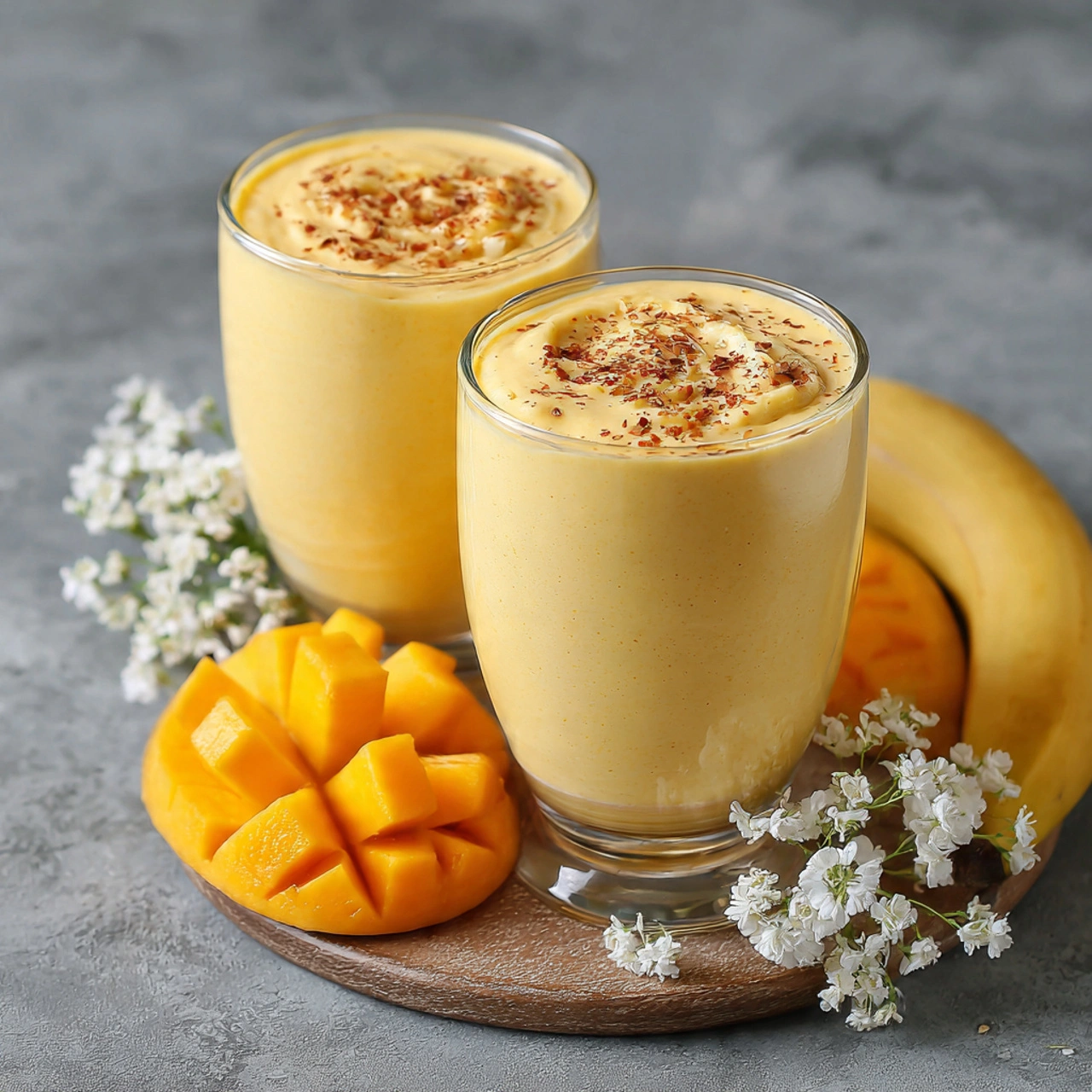
Finally, increase to the highest speed setting and blend for 30-60 seconds until the Mango Banana Smoothie is completely smooth, creamy, and uniform. The texture should resemble soft-serve ice cream or a very thick milkshake—so thick that it almost doesn’t pour, instead slowly oozing out of the blender. This is exactly what you want.
Texture milestone: When you lift the blender lid, you should see a completely uniform golden-yellow color with no white streaks (unblended banana), no orange chunks (mango pieces), and a surface so smooth it’s almost glossy. The consistency should hold soft peaks like thick frosting.
Step 4: Assess and Adjust (30 seconds)
This crucial step separates good smoothies from exceptional ones. Use a spoon to scoop out a small taste and evaluate:
Too thick to blend? Add milk one tablespoon at a time, blending for 10 seconds after each addition. Don’t add too much—this smoothie is supposed to be thick.
Too thin? Add more frozen banana or frozen mango and blend again. You want a thick, spoonable consistency.
Not sweet enough? Drizzle in honey or maple syrup, starting with 1 teaspoon, and blend briefly. Remember, very cold foods taste less sweet, so the smoothie will seem slightly sweeter as it warms to drinking temperature.
Perfect but wants more mango flavor? Add a few more frozen mango chunks and blend.
Perfect but wants more banana flavor? Add another half frozen banana and blend.
Needs brightness? A tiny squeeze of lime juice (just ¼ teaspoon) can make all the flavors pop without being identifiable.
Step 5: Serve Immediately (30 seconds)
Pour (or more accurately, spoon) your Mango Banana Smoothie into a chilled glass. Because it’s so thick, you might need to use a spatula to scoop it out of the blender and into your glass.
For the most Instagram-worthy presentation, pour into a clear glass or mason jar so you can see that gorgeous golden color. Top with optional garnishes like a banana slice, a mango chunk, a sprinkle of coconut flakes, or a fresh mint sprig.
This smoothie is best enjoyed with a thick smoothie straw or even a spoon—it’s truly that thick and creamy. Serve immediately while it’s perfectly cold and at peak texture. The longer it sits, the more it will soften and eventually separate.
Pro Tips for the Perfect Mango Banana Smoothie
The Frozen Banana Secret
This is the single most important tip for the best Mango Banana Smoothie: always use frozen bananas. Fresh bananas simply cannot create the same thick, creamy, ice-cream-like texture that frozen bananas provide. When bananas freeze, their starches change structure, and when blended, they create an incredibly smooth, almost custard-like consistency that’s absolutely magical.
How to freeze bananas properly:
- Use ripe bananas (yellow with brown spots for maximum sweetness)
- Peel completely before freezing (frozen peels are impossible to remove)
- Slice or break into 1-inch chunks for easier blending
- Arrange in a single layer on a baking sheet lined with parchment
- Freeze for at least 2 hours until solid
- Transfer to a freezer bag, removing as much air as possible
- Store for up to 3 months
Pro freezing tip: Freeze bananas that are at various stages of ripeness. Slightly less ripe bananas (more yellow than brown) create a firmer texture, while very ripe bananas (lots of brown spots) are sweeter but create a softer consistency. Having both options lets you customize texture.
Fresh vs. Frozen Mango
While frozen bananas are non-negotiable, you have more flexibility with mangoes. Both fresh and frozen work beautifully, each with distinct advantages:
Frozen mango advantages:
- Available year-round regardless of season
- Already peeled and cubed (no prep work)
- Creates thicker, colder smoothie
- More economical, especially off-season
- Flash-frozen at peak ripeness for consistent sweetness
Fresh mango advantages:
- Peak season flavor is unbeatable (late spring/summer)
- More aromatic and vibrant
- You control the ripeness
- No ice crystals or freezer taste
Best approach: Use frozen mango for convenience and year-round smoothies, but splurge on fresh mangoes during peak season (May-August) when they’re incredibly sweet and fragrant.
The Liquid Ratio is Critical
The biggest mistake people make with this smoothie is adding too much liquid, which destroys the thick, creamy texture that makes it special. Start with just ½ cup of milk—that’s it. This seems like almost nothing, but frozen bananas and mangoes release moisture as they blend, so you need less liquid than you think.
Liquid guidelines:
- For very thick, spoonable smoothie bowl: ¼ cup milk
- For thick, classic smoothie (recommended): ½ cup milk
- For thinner, drinkable smoothie: ¾ cup milk maximum
Recovery tip: If you accidentally add too much liquid and your smoothie is too thin, rescue it by adding more frozen banana or frozen mango. You can also add ice cubes and blend again, though this slightly dilutes the flavor.
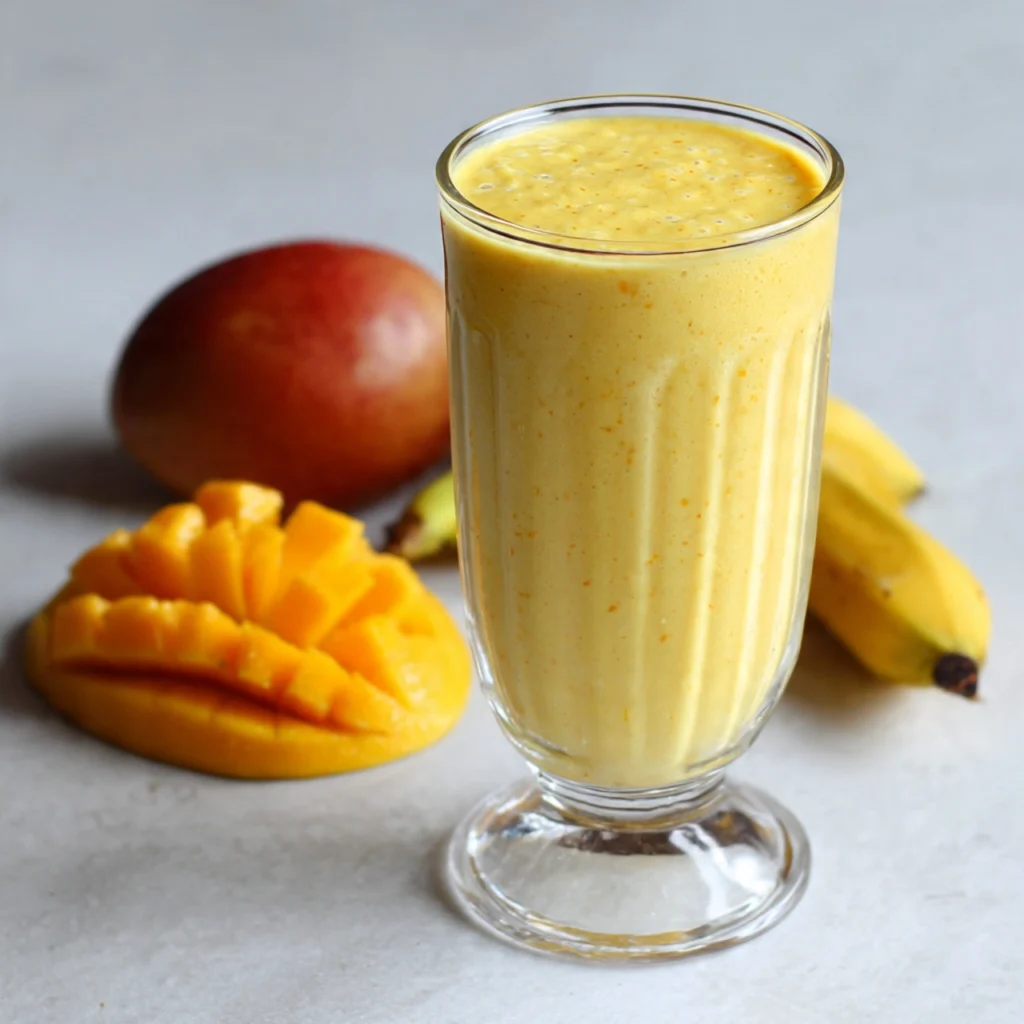
Achieving the Perfect Sweetness
One of the beautiful things about this Mango Banana Smoothie is that it usually needs zero added sweetener if you use properly ripe fruit. Ripe mangoes are naturally candy-sweet, and bananas with brown spots are incredibly sweet on their own. Together, they create a smoothie that tastes almost dessert-like without any added sugar.
Sweetness strategy:
- Always taste your fruit before blending
- Use the ripest bananas possible (more brown spots = sweeter)
- Choose sweet mango varieties (Alphonso, Ataulfo, Kent)
- Only add sweetener after blending and tasting if needed
- Remember: frozen smoothies taste less sweet, so they’ll seem sweeter at drinking temperature
Natural sweetness boosters if needed:
- 1-2 pitted Medjool dates (whole food option with fiber)
- 1 teaspoon honey or maple syrup
- 1-2 teaspoons agave nectar
- An extra half banana
Protein and Nutrition Boosting
While this smoothie is already nutritious (packed with vitamins, minerals, and fiber from whole fruit), you can enhance it further for a more complete meal:
Protein additions:
- 1 scoop vanilla or unflavored protein powder (20-25g protein)
- ½ cup Greek yogurt (10-15g protein, adds tanginess)
- 2 tablespoons hemp hearts (6g protein, omega-3s)
- 1-2 tablespoons nut butter (4-8g protein, healthy fats)
Healthy fats:
- 1 tablespoon almond or peanut butter
- ¼ avocado (creates extra creaminess)
- 1 tablespoon ground flaxseed or chia seeds
- 1 tablespoon coconut oil
Greens addition:
- 1-2 cups fresh baby spinach (blends invisibly)
- The strong mango-banana flavor completely masks spinach
- Smoothie may turn slightly more golden-green but tastes purely fruity
Superfood boost:
- 1 tablespoon chia seeds (omega-3s, fiber)
- ½ teaspoon turmeric (anti-inflammatory)
- ¼ teaspoon ground ginger (digestive aid)
- 1 teaspoon maca powder (energy, hormone balance)
Blender Power Matters
High-powered blenders (Vitamix, Blendtec, Ninja) create the absolute smoothest, creamiest results with frozen fruit. However, you can still make excellent smoothies with less powerful blenders if you use these techniques:
For standard blenders:
- Let frozen fruit sit at room temperature for 5 minutes to soften
- Cut frozen banana into smaller chunks before freezing
- Add liquid and blend briefly before adding frozen fruit
- Use pulse function initially to break down large pieces
- Stop and scrape down sides multiple times
- Be patient—allow 2-3 minutes of total blending time
- Consider adding an extra splash of liquid if motor struggles
For personal/bullet blenders:
- Use smaller portions (half recipe at a time)
- Ensure liquid fully covers the blades before adding fruit
- Frozen fruit should be quite small pieces
- Shake or tap the blender between pulses to redistribute
Common Mistakes to Avoid
Mistake #1: Using Fresh (Not Frozen) Bananas
The single biggest mistake is using fresh bananas instead of frozen. Fresh bananas don’t create the thick, creamy, ice-cream-like texture that makes this smoothie special. Even with ice added, fresh bananas produce a thinner, less satisfying consistency.
The fix: Always freeze your bananas. Peel them first, break into chunks, and freeze for at least 2 hours. This one change will dramatically improve your smoothie.
Mistake #2: Adding Too Much Liquid
Many people panic when their blender struggles with frozen fruit and immediately add lots of liquid. This creates a thin, watery smoothie that’s disappointing and nothing like the thick, creamy version you’re aiming for.
The fix: Start with just ½ cup milk and add more only if absolutely necessary, one tablespoon at a time. Remember, you can always thin a smoothie, but you can’t thicken a watery one without adding more fruit.
Mistake #3: Using Underripe Fruit
Underripe bananas (still greenish) are starchy and bland, not sweet. Underripe mangoes are fibrous, sour, and unpleasant. Using underripe fruit creates a smoothie that tastes flat and requires excessive sweetener to be palatable.
The fix: Only use ripe bananas (yellow with brown spots) and ripe mangoes (soft, fragrant, sweet). If your fruit isn’t ripe, let it sit at room temperature for 2-4 days before using or freezing.
Mistake #4: Over-Blending
While you want a smooth texture, blending for too long (over 2-3 minutes continuously) can warm up your smoothie from blade friction, causing it to become thinner and less refreshing. Some blenders generate significant heat.
The fix: Blend just until smooth with no visible chunks—typically 60-90 seconds total. The smoothie should still be very cold when poured.
Mistake #5: Using Ice When Fruit is Already Frozen
If you’re using frozen banana and frozen mango, you don’t need ice. Adding ice just dilutes the flavor and creates unnecessary work for your blender.
The fix: Skip ice entirely when using frozen fruit. Only add ice if you’re using fresh fruit and need the cold temperature and thickness.
Mistake #6: Not Tasting Before Serving
Fruit sweetness varies based on ripeness, variety, and season. A recipe that was perfectly sweet last week might need adjustment this week with different fruit.
The fix: Always taste your smoothie before serving. Adjust sweetness, thickness, or flavor balance as needed. This 15-second step ensures consistent deliciousness.
Mistake #7: Storing for Too Long
While smoothies can be stored, this particular smoothie is best fresh. The banana oxidizes (browns) over time, and the texture becomes less appealing as it separates and warms.
The fix: Make and drink immediately for best results. If you must store, do so for no more than 6-8 hours maximum.
Storage and Serving Suggestions
Immediate Serving (Best Option)
This Mango Banana Smoothie reaches absolute perfection within 5-10 minutes of blending. The texture is thick and creamy, the temperature is ideal, and the flavor is at its brightest. Pour into a chilled glass and enjoy immediately with a thick straw or spoon.
Short-Term Refrigeration Mango Banana Smoothie (Same Day)
If you need to make your smoothie a few hours ahead, it can be refrigerated for 6-8 hours maximum. Pour into an airtight container or mason jar, filling completely to the top to minimize air exposure. Seal tightly and refrigerate.
Before drinking, the smoothie will have separated and the banana may have oxidized slightly (turned brownish on top). This is normal. Simply shake vigorously for 20-30 seconds, or pour back into the blender and pulse a few times to recombine. The texture won’t be quite as perfect as fresh, but it’s still tasty.
Oxidation prevention: Add a squeeze of lemon or lime juice before storing—the acidity helps prevent browning.
Freezer Storage (Up to 3 Months)
Mango Banana Smoothies freeze very well. Pour into freezer-safe containers or mason jars, leaving 1 inch of headspace for expansion. Seal tightly and freeze for up to 3 months.
To thaw: Transfer from freezer to refrigerator overnight. In the morning, it will be partially thawed with a thick, icy consistency. Either eat it with a spoon (refreshing!), or pour into your blender with 2-3 tablespoons of milk and blend for 20 seconds to restore the smooth texture.
Quick-thaw method: Let frozen smoothie sit at room temperature for 20 minutes, break into chunks with a spoon, then blend with a splash of milk.
Smoothie Popsicles
Transform your Mango Banana Smoothie into healthy frozen treats by pouring into popsicle molds. These are fantastic for kids, summer snacks, or post-workout treats. Freeze for 4-6 hours or overnight. Store for up to 2 months.
Smoothie Bowl Transformation
Turn this into a beautiful breakfast bowl by using less liquid (just ¼ cup milk) for an extra-thick, spoonable consistency. Pour into a bowl and create an artistic arrangement of toppings:
Topping suggestions:
- Fresh banana slices and mango cubes
- Granola or muesli for crunch
- Coconut flakes (toasted for extra flavor)
- Fresh berries (strawberries, blueberries)
- Chia seeds or hemp hearts
- Sliced almonds or chopped cashews
- Drizzle of honey or almond butter
- Fresh mint leaves
- Cacao nibs for chocolate notes
Arrange toppings in neat sections or artistic patterns for a gorgeous, Instagram-worthy breakfast.
Mango Banana Smoothie Meal Prep Strategy
The smartest way to prep this smoothie is to create “smoothie packs”—individual freezer bags with pre-measured frozen banana chunks and frozen mango pieces. When ready to blend, dump one bag into your blender, add milk, and blend. This gives you all the convenience of meal prep without sacrificing freshness.
Smoothie pack contents:
- 1 large banana’s worth of frozen chunks
- 1 cup frozen mango pieces
- Optional: 1 tablespoon chia seeds
Store 5-7 packs in your freezer for grab-and-go smoothie assembly.
Portion Recommendations
This recipe makes approximately 1.5-2 cups (12-16 oz) of smoothie:
- Single serving as a meal replacement (full recipe)
- Two small servings as a snack (6-8 oz each)
- One smoothie bowl with toppings
For children: One full recipe is perfect for 2-3 kids
For athletes: Full recipe plus protein powder makes an excellent recovery drink
For weight management: Half recipe (6-8 oz) is a satisfying snack
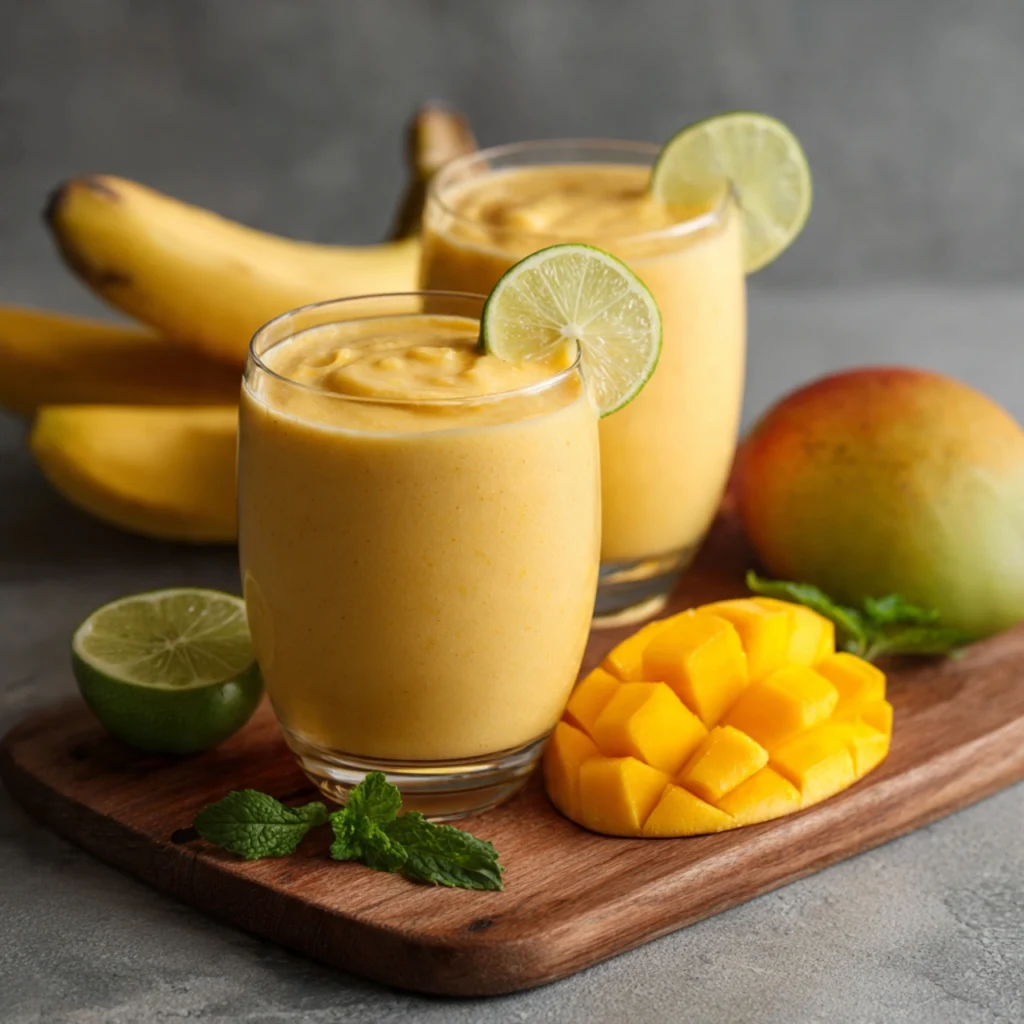
FAQ (Frequently Asked Questions)
1. Can I make this Mango Banana Smoothie without any added liquid?
It’s extremely difficult to blend frozen fruit without any liquid at all—your blender will struggle and potentially overheat or burn out the motor. However, you can minimize liquid for an ultra-thick, nice-cream-like texture. Use just 2-3 tablespoons of milk (the absolute minimum), and be prepared to use a tamper tool or stop the blender multiple times to scrape down and redistribute ingredients. High-powered blenders like Vitamix handle minimal liquid better than standard blenders. The result will be so thick you’ll need to eat it with a spoon—almost like frozen yogurt or soft-serve ice cream.
2. Why does my smoothie taste bland even though I used ripe fruit?
Blandness typically results from one of several issues. First, frozen fruit sometimes tastes less sweet than fresh because cold temperatures suppress sweetness perception—your smoothie will taste sweeter as it warms slightly to drinking temperature, so give it a minute before adding sweetener. Second, if you used frozen banana that was underripe when frozen (still greenish rather than yellow with brown spots), it won’t have developed full sweetness—banana sweetness comes from starches converting to sugars as it ripens. Third, some mango varieties are naturally less flavorful than others; Tommy Atkins mangoes are much milder than Alphonso or Ataulfo. Fourth, over-diluting with too much liquid can water down the flavors—stick to minimal liquid.
3. Can I use other fruits instead of mango?
Absolutely! While mango and banana is a classic combination, banana’s incredible creaminess pairs beautifully with many fruits. Strawberries create a pink smoothie with berry flavor. Blueberries make a purple smoothie packed with antioxidants. Pineapple creates an intensely tropical smoothie. Peaches make a peachy-cream smoothie reminiscent of peach ice cream. Raspberries or blackberries create tart, vibrant smoothies. Mixed berries offer complex flavor. The key is maintaining the 1:1 ratio of banana to other fruit for proper consistency and flavor balance. Banana should always be the base because it provides the signature creamy texture—without banana, you won’t get that thick, ice-cream-like consistency that makes this smoothie special.
4. Is this smoothie suitable for people trying to lose weight?
This Mango Banana Smoothie can absolutely fit into a weight loss plan when consumed mindfully and in appropriate portions. One full recipe contains approximately 200-250 calories, primarily from natural fruit sugars and carbohydrates. The fiber from whole fruit helps with satiety and digestive health. The natural sugars provide energy without the blood sugar spikes of refined sugars. However, because it’s naturally quite high in carbohydrates and relatively low in protein and fat, it’s not the most balanced meal on its own for weight loss.
5. How do I make this smoothie if I don’t have a high-powered blender?
Standard blenders can absolutely make this smoothie with a few strategic adjustments. First and most importantly, let your frozen fruit soften at room temperature for 5-7 minutes—slightly thawed fruit blends much more easily while still maintaining thickness. Second, cut your frozen banana into smaller chunks (½-inch pieces instead of 1-inch) before freezing for easier processing. Third, use the pulse function initially to break down frozen chunks before switching to continuous blending—this prevents the motor from getting overwhelmed. Fourth, add milk first and blend it briefly before adding frozen fruit to create a liquid base. Fifth, add frozen fruit in two batches rather than all at once, blending the first batch until relatively smooth before adding more.
6. Can I add vegetables to this smoothie without tasting them?
Yes! The strong, sweet flavors of mango and banana effectively mask mild vegetables. You can add 1-2 cups of fresh baby spinach without detecting it at all in the final smoothie—baby spinach has very mild flavor and blends completely invisibly when combined with sweet fruits. The smoothie color may shift slightly from pure golden-yellow to a more greenish-gold or yellowish-green (depending on how much spinach you add), but the taste remains purely sweet and fruity with no vegetable flavor whatsoever. Frozen cauliflower florets (½-¾ cup) also work brilliantly—they add creaminess, fiber, and vitamins without affecting flavor at all, and they don’t change the color. Frozen zucchini (peeled, about ½ cup) is another neutral option.
7. Why is my smoothie too thick/not pourable?
An extremely thick smoothie that won’t pour is usually the result of using all frozen fruit with minimal liquid—which actually creates the most delicious, ice-cream-like texture! This isn’t necessarily a problem; it just means you’ve made more of a smoothie bowl than a drinkable smoothie. If you prefer a pourable consistency: add milk one tablespoon at a time, blending for 10 seconds after each addition, until you reach your desired thickness. Add 2-4 tablespoons total to transform it from spoonable to drinkable while maintaining good thickness. Alternatively, let the smoothie sit at room temperature for 2-3 minutes—as the frozen fruit warms slightly, the consistency naturally thins.
Nutrition Information (Mango Banana Smoothie)
Serving Size: 1 smoothie (full recipe, about 16 oz)
Servings Per Recipe: 1
Calories: 210-250 kcal
Total Fat: 1.5g
- Saturated Fat: 0.5g
- Trans Fat: 0g
Cholesterol: 0mg (with non-dairy milk; 5mg with dairy milk)
Sodium: 50mg
Total Carbohydrates: 54g
- Dietary Fiber:** 6g
- Sugars: 39g (all naturally occurring from fruit)
- Added Sugars: 0g (if no sweetener added)
Protein: 3g (with non-dairy milk; 4-5g with dairy milk)
Vitamin D: 1mcg (5% DV, from fortified milk)
Calcium: 150mg (12% DV)
Iron: 0.8mg (4% DV)
Potassium: 650mg (14% DV)
Vitamin A: 120mcg (13% DV)
Vitamin C: 65mg (72% DV)
Vitamin B6: 0.6mg (35% DV)
Folate: 45mcg (11% DV)
Additional Micronutrients:
- Excellent source of Vitamin C (immune support, collagen production, antioxidant)
- Excellent source of Vitamin B6 (brain health, mood regulation)
- Good source of potassium (heart health, blood pressure, muscle function)
- Good source of manganese (bone health, metabolism)
- Rich in antioxidants (especially from mango)
- Contains prebiotic fiber (supports digestive health)
- Provides magnesium (muscle relaxation, sleep quality)
Notes on Nutrition:
- Values based on using 1 large banana, 1 cup mango, and unsweetened almond milk
- Using dairy milk adds approximately 40 calories and 4g protein
- Adding honey/maple syrup adds 20-40 calories and 5-10g added sugars
- Adding Greek yogurt adds 60-80 calories, 10-15g protein, and changes macros significantly
- Adding protein powder adds 100-120 calories and 20-25g protein
- Fresh vs. frozen fruit doesn’t significantly impact nutritional values
- Naturally vegan and dairy-free (with non-dairy milk)
- Naturally gluten-free
- High in natural sugars but also high in fiber which moderates blood sugar impact
Final Thoughts
This Mango Banana Smoothie is proof that the simplest recipes are often the most perfect. Four ingredients. Three minutes. Zero complicated techniques or expensive equipment. Yet the result is something so creamy, so naturally sweet, and so satisfying that it genuinely rivals any premium smoothie shop creation—without the premium price tag or the long lines.
What I love most about this smoothie is how it democratizes healthy eating. You don’t need to be a wellness influencer, a trained chef, or someone with a pantry full of exotic superfoods to make something absolutely delicious and genuinely nourishing.
Over the years of making and sharing this Mango Banana Smoothie recipe, I’ve witnessed it become a game-changer for so many people. Parents tell me their fruit-resistant kids now ask for “the yellow smoothie” every morning.
The beauty lies not just in taste but in versatility. Make it thick for smoothie bowls topped with granola and fresh fruit. Make it thinner for easy sipping on your commute. Add greens for extra nutrition without affecting flavor. Include protein powder for sustained energy.
I encourage you to make this Mango Banana Smoothie recipe a regular part of your routine. Freeze a bunch of ripe bananas this weekend. Keep frozen mango in your freezer. Then, on those busy mornings when you’re tempted to skip breakfast or grab something less healthy, you’ll have everything you need for a genuinely delicious, satisfying.
Here’s to simple pleasures, to the magic of frozen bananas, and to discovering that healthy eating doesn’t have to be complicated, expensive, or tasteless. May your freezer be forever stocked with ripe bananas and golden mangoes, and may every sip remind you that nourishing your body can be absolutely Mango Banana Smoothie delicious.
Blend with joy, sip with gratitude, and savor every creamy, tropical moment!
PrintMango Banana Smoothie: The Creamiest 4-Ingredient Recipe (3 Minutes)
This Mango Banana Smoothie is the creamiest, most naturally sweet smoothie you’ll ever make—thick enough to eat with a spoon, yet made with just 4 simple ingredients. The magic comes from frozen bananas that create an ice-cream-like texture and ripe mangoes that provide tropical sweetness and gorgeous golden color. No added sugars, no protein powders, no complicated ingredients—just pure fruit blended into something that tastes like a decadent dessert but is actually a healthy breakfast. Ready in 3 minutes and naturally vegan, this smoothie is perfect for busy mornings, post-workout recovery, or any time you crave something sweet and satisfying.
- Prep Time: 3 minutes
- Cook Time: 0 minutes
- Total Time: 3 minutes
- Yield: 1 large smoothie (16 oz) or 2 small servings (8 oz each)
- Category: Breakfast, Smoothie, Snack, Beverage, Healthy Drink
- Method: Blending
- Cuisine: Tropical-inspired, American, Fusion
- Diet: Vegetarian
Ingredients
- 1 large ripe banana (fresh or preferably frozen, about 120g)
- 1 cup ripe mango chunks (fresh or frozen, about 150g)
- ½ cup milk (dairy or non-dairy—almond, coconut, or oat milk work beautifully)
- ½ cup ice cubes (about 4-5 cubes; omit if using frozen banana and frozen mango)
- Optional: 1-2 teaspoons honey or maple syrup (only if fruit isn’t sweet enough)
Optional Add-Ins:
- ½ cup plain Greek yogurt (adds protein and tanginess)
- 1 tablespoon chia seeds (omega-3s and fiber)
- 1 scoop vanilla protein powder (high-protein version)
- ¼ teaspoon vanilla extract (added depth)
- Handful of spinach (hidden greens)
- 1 tablespoon almond or peanut butter (healthy fats)
- ¼ cup orange juice (tropical boost)
Garnish Options:
- Fresh banana slice
- Fresh mango cube
- Coconut flakes
- Fresh mint sprig
Instructions
- Prepare fruit: If using fresh banana, peel and break into chunks. If using fresh mango, peel and cube. For best results, use frozen banana chunks and frozen mango pieces—this creates the thickest, creamiest texture. If fruit is frozen, let sit at room temperature for 1-2 minutes to soften very slightly.
- Layer ingredients: Add milk to blender first (this is your liquid base). Add mango chunks next. Top with banana chunks. Add ice only if you’re using fresh (not frozen) fruit.
- Blend to perfection: Start on low speed for 15-20 seconds to break down frozen chunks. Increase to medium for 20-30 seconds, using tamper or stopping to scrape sides if needed. Finish on high speed for 30-60 seconds until completely smooth and creamy with no visible fruit chunks. The texture should be very thick—like soft-serve ice cream.
- Assess and adjust: Taste the smoothie. If too thick to blend, add milk 1 tablespoon at a time. If not sweet enough, add honey. If too thin, add more frozen fruit. The ideal texture is thick, creamy, and barely pourable.
- Serve immediately: Pour (or spoon) into a chilled glass. Enjoy right away with a thick straw or spoon for best texture and temperature.
Notes
- Frozen banana is KEY: This creates the ice-cream-like texture. Always freeze ripe (yellow with brown spots) bananas.
- No ice needed: If using frozen banana and frozen mango, skip ice entirely—it dilutes flavor.
- Minimal liquid: Start with just ½ cup milk. Too much liquid ruins the thick texture.
- Ripeness matters: Use very ripe fruit (banana with brown spots, sweet mango) for maximum natural sweetness.
- Consistency control: For thicker smoothie bowl, use only ¼ cup milk. For thinner drinkable smoothie, use up to ¾ cup.
- Protein boost: Add Greek yogurt or protein powder for meal replacement.
- Make-ahead: Pre-portion frozen fruit in bags for quick blending.
- Storage: Best fresh; can refrigerate for 6-8 hours but texture and color decline.