Introduction
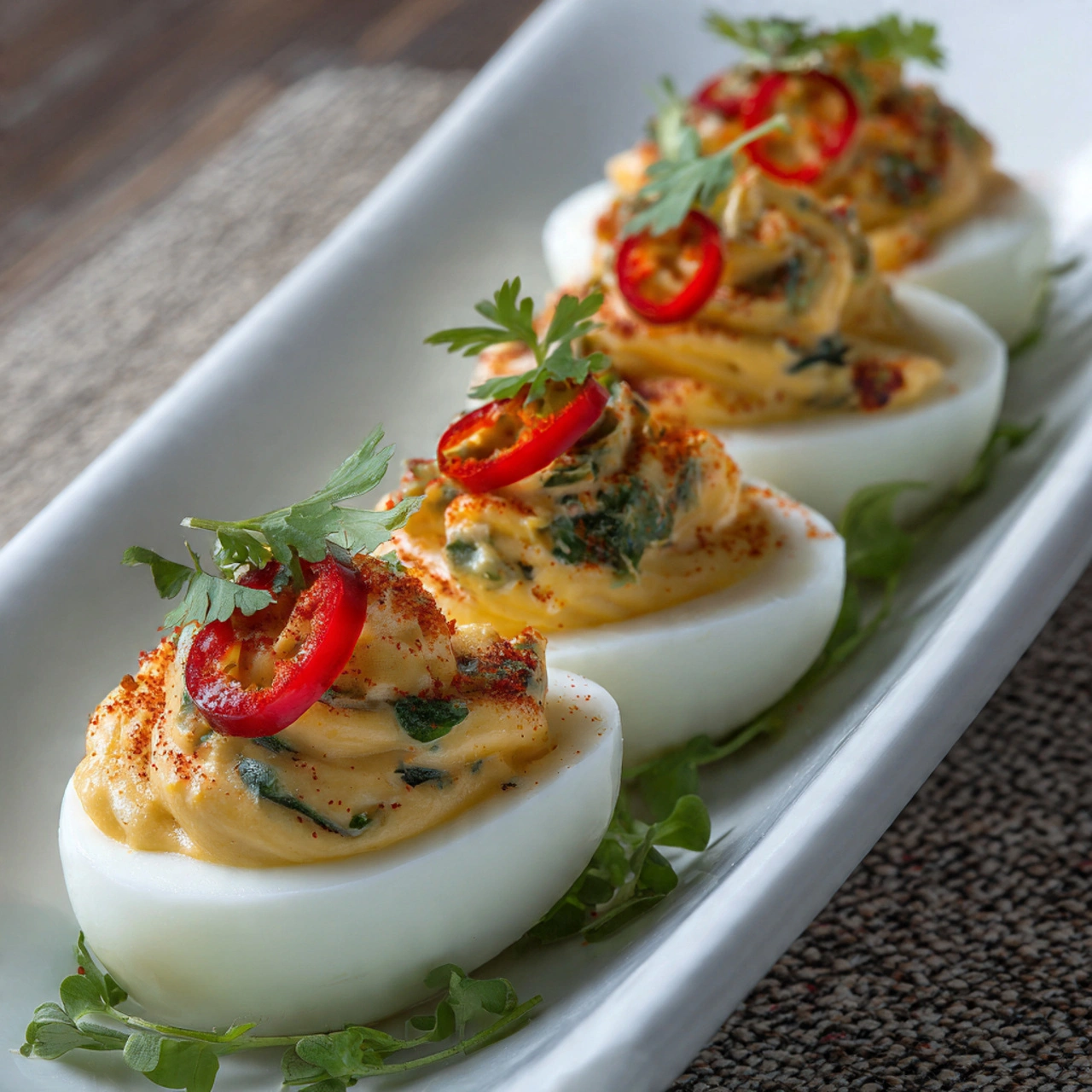
Deviled Eggs are the undisputed champion of party appetizers—those elegant little bites with their creamy, tangy filling piped into perfectly smooth egg white halves that disappear from platters faster than anything else at potlucks, holiday gatherings, and family reunions. These aren’t just eggs with mayonnaise; they’re a carefully balanced combination of rich yolks, sharp mustard, acidic vinegar, and subtle seasonings that create something far more sophisticated and crave-worthy than their simple ingredients might suggest.
I’ll never forget my grandmother’s deviled eggs. She’d make dozens for every family gathering, arranged meticulously on her vintage crystal platter with a sprinkle of paprika that looked like tiny works of art. As a child, I’d hover near that platter waiting for permission to take one, and I was never disappointed—her filling was impossibly creamy, perfectly seasoned.
Years later, when I decided to recreate her recipe, I realized that while deviled eggs seem simple, there’s actually significant technique involved in making them truly excellent. The eggs must be cooked perfectly—no green rings around the yolks, no rubbery whites, and they must peel cleanly without leaving crater-like divots.
After making literally hundreds of batches and testing every variable imaginable (egg freshness, cooking methods, cooling techniques, filling ratios, seasoning combinations), I’ve developed a foolproof method that produces restaurant-quality Deviled Eggs every single time.
What makes these Deviled Eggs exceptional is the attention to small details that transform them from ordinary to extraordinary. We’re talking about eggs that peel effortlessly in one smooth motion, yolks that whip into a silky filling with no lumps, and seasoning that’s so perfectly balanced you can’t quite identify individual flavors—just pure deliciousness.
Let me walk you through creating the absolute best Deviled Eggs you’ve ever tasted—the ones that will have people asking for your secret.
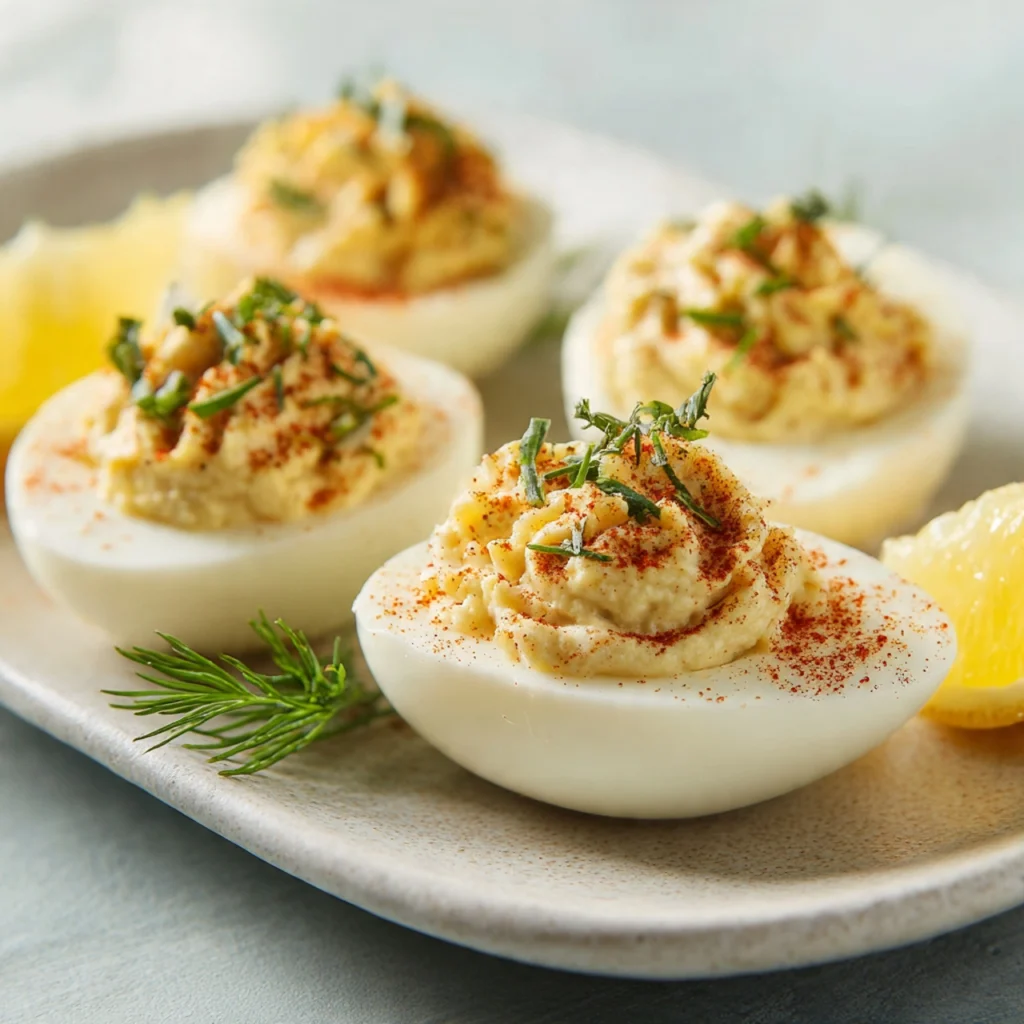
Ingredients
For Classic Deviled Eggs (12 servings/24 halves):
For the Eggs:
- 6 large eggs (preferably 7-10 days old, not super fresh)
- Water (enough to cover eggs by 1 inch)
- Ice bath (large bowl filled with ice and cold water)
- Pinch of salt (optional, for boiling water)
The Filling:
- 3 tablespoons mayonnaise (Duke’s, Hellmann’s, or Best Foods recommended)
- 1½ teaspoons Dijon mustard (or yellow mustard for milder flavor)
- 1½ teaspoons white vinegar (or apple cider vinegar)
- ¼ teaspoon fine sea salt (adjust to taste)
- ⅛ teaspoon black pepper (freshly ground preferred)
- Pinch of cayenne pepper (optional, for subtle heat)
For Garnishing:
- Paprika (sweet, smoked, or Hungarian)
- Fresh chives or parsley (finely chopped)
- Everything bagel seasoning (optional, trendy variation)
Flavor Variations:
Southern-Style:
- Add 1 tablespoon sweet pickle relish
- Use yellow mustard instead of Dijon
- Increase mayo to 4 tablespoons
Bacon Deviled Eggs:
- Add 2 strips cooked, crumbled bacon to filling
- Garnish with bacon pieces
- Add ½ teaspoon bacon fat to filling
Spicy Sriracha:
- Add 1-2 teaspoons sriracha to filling
- Garnish with sriracha drizzle
- Top with sliced jalapeños
Avocado Deviled Eggs:
- Replace half the mayo with mashed avocado
- Add squeeze of lime juice
- Garnish with cilantro
Herb Garden:
- Add 1 tablespoon fresh dill, chives, and parsley
- Use lemon juice instead of vinegar
- Garnish with more fresh herbs
Buffalo Style:
- Add 1-2 tablespoons buffalo sauce
- Mix in ¼ cup crumbled blue cheese
- Garnish with celery leaves
Step-by-Step Instructions
Step 1: Prepare and Cook the Eggs (12 minutes)
The foundation of perfect Deviled Eggs is perfectly hard-boiled eggs. Place your eggs in a single layer in a medium saucepan. Add cold water until it covers the eggs by about 1 inch. This ensures even heating and prevents cracking.
Place the saucepan over high heat and bring to a full rolling boil. You’ll see large bubbles breaking the surface consistently. The moment the water reaches a full boil, remove the pan from heat, cover it with a tight-fitting lid, and let the eggs sit undisturbed for exactly 12 minutes.
Why this method works: The residual heat cooks the eggs gently and evenly, preventing the rubbery texture and green-gray ring around the yolk that comes from overcooking. This timing produces fully-cooked yolks that are bright yellow, creamy, and never chalky.
Temperature note: If you’re at high altitude (above 3,000 feet), you may need to increase the standing time to 13-14 minutes. The lower boiling temperature at altitude requires slightly longer cooking.
Step 2: Ice Bath Shock (5 minutes)
While your eggs are cooking, prepare a large ice bath—fill a big bowl with ice cubes and cold water. The moment your 12-minute timer goes off, immediately transfer the eggs to the ice bath using a slotted spoon. Let them sit for at least 5 minutes, though 10 minutes is even better if you have time.
Why this step is crucial: The rapid temperature change stops the cooking process immediately, preventing overcooking. It also causes the egg whites to contract slightly, creating a small gap between the white and the shell membrane that makes peeling dramatically easier. This single step is the difference between eggs that peel beautifully and eggs that tear and stick frustratingly.
Step 3: Peel the Eggs (3 minutes)
Once fully cooled, it’s time to peel. Gently tap each egg all over on your countertop to create a network of fine cracks in the shell. Start peeling from the wider end where the air pocket is located—this is the easiest entry point.
Peel under gently running cool water, or keep a small bowl of water nearby to dip the eggs as you work. The water helps separate the membrane from the white and washes away small shell fragments.
Peeling technique: Try to get under the thin membrane that sits between the shell and the white—once you’re under this membrane, the shell often comes off in large pieces rather than tiny fragments. Work gently but deliberately. If an egg is being particularly stubborn, return it to the water for another minute.
The age factor: Eggs that are 7-10 days old peel significantly easier than super fresh eggs (1-3 days old). Fresh eggs have a lower pH that causes the membrane to stick to the whites. As eggs age, the pH increases and peeling becomes easier. If you’re planning to make deviled eggs, buy your eggs a week in advance.
Step 4: Halve and Remove Yolks (2 minutes)
Pat your peeled eggs completely dry with paper towels—any moisture will make them slippery and harder to work with. Using a sharp knife (wipe it clean between cuts for the prettiest halves), slice each egg lengthwise in half.
Gently remove the yolks and place them in a medium mixing bowl. Arrange your egg white halves on a serving platter. If some whites wobble and won’t sit flat, slice a tiny bit off the bottom to create a stable base—but do this carefully so you don’t create a hole for filling to leak through.
Organization tip: I like to arrange my egg white halves on the serving platter before making the filling. This way, I know exactly how many halves I have and can ensure my filling is the right consistency and amount.
Step 5: Make the Filling (3 minutes)
Add mayonnaise, Dijon mustard, vinegar, salt, pepper, and cayenne (if using) to the bowl with your yolks. Using a fork, mash everything together thoroughly. At first, it will look lumpy and rough, but keep mashing and stirring.
Once the mixture is relatively combined, switch to a whisk or hand mixer and beat for 30-60 seconds until the filling is completely smooth and creamy with no visible lumps. The texture should be similar to thick frosting—smooth, pipeable, but not runny.
Taste and adjust: This is the critical step most people skip! Taste your filling and adjust seasoning. Does it need more tang? Add a touch more vinegar or mustard. Too tangy? Add a bit more mayo. Not enough depth? Add a pinch more salt. The filling should taste bold and well-seasoned because the bland egg whites will mellow it.
Consistency check: The filling should hold its shape when piped but not be so stiff that it’s dry or crumbly. If it’s too thick, add mayo or a tiny bit of water (½ teaspoon at a time). If it’s too thin, add more mashed yolk or a tiny bit of mayo.
Step 6: Fill the Eggs (5 minutes)
You have two options for filling: the rustic spoon method or the elegant piping method.
Spoon method: Use a small spoon to scoop filling into each egg white half, mounding it slightly. Smooth the top with the back of the spoon for a neat appearance. This method is faster and more casual.
Piping method: Transfer your filling to a piping bag fitted with a star tip (or a heavy-duty ziplock bag with one corner snipped off). Pipe the filling into each egg white half in a decorative swirl, starting from the center and spiraling outward. This creates the classic, elegant deviled egg appearance.
Pro filling tip: Don’t overfill. The filling should be generous but not overflowing—about 1-1.5 tablespoons per half. Overfilled eggs are messy to eat and don’t look as refined.
Step 7: Garnish and Chill (1 minute + chilling time)
Lightly sprinkle each deviled egg with paprika—this is the classic finishing touch. You can use sweet paprika for mild flavor and beautiful red color, smoked paprika for subtle smokiness, or Hungarian paprika for a bit of heat.
If using fresh herbs, sprinkle them on now. Cover your platter loosely with plastic wrap and refrigerate for at least 30 minutes before serving (1-2 hours is even better). This chilling time allows the flavors to meld and the eggs to firm up slightly, making them easier to handle and even more delicious.
Make-ahead advantage: Deviled Eggs actually taste better after sitting for a few hours as the flavors marry together. You can make them up to 24 hours in advance.
Pro Tips for the Perfect Deviled Eggs
The Perfect Hard-Boiled Egg Every Time
Consistent, perfect hard-boiled eggs are the foundation of great deviled eggs. Here’s what I’ve learned after cooking thousands of eggs:
Steam method (alternative): Place eggs in a steamer basket over 1 inch of boiling water, cover, and steam for exactly 12 minutes, then ice bath. This method is even more foolproof than boiling because the eggs aren’t bouncing around potentially cracking.
Instant Pot method: Place eggs on the trivet with 1 cup water, pressure cook on high for 5 minutes, allow 5-minute natural release, then quick release and immediately ice bath. This produces incredibly easy-to-peel eggs.
The wiggle test: After cooking and chilling, wiggle your eggs gently. If they rotate freely in the shell, they’re perfectly cooked. If they don’t rotate, they’re undercooked.
Achieving Silky Smooth Filling
The texture of your filling separates amateur deviled eggs from professional-quality ones:
Use a food processor: For the absolute smoothest filling, pulse your yolks with the other ingredients in a food processor for 30-45 seconds. This creates an incredibly silky, luxurious texture.
Pass through a sieve: For competition-level smoothness, press your mashed yolk mixture through a fine-mesh sieve before adding other ingredients. This removes any stubborn lumps.
Room temperature ingredients: Let your eggs come to room temperature before making the filling (after the initial chilling for peeling). Cold yolks are harder to mash smoothly.
The mayo matters: Use good-quality, full-fat mayonnaise. Duke’s and Hellmann’s/Best Foods produce the creamiest results. Low-fat mayo creates a thinner, less luxurious filling.
Preventing the Green Ring
That greenish-gray ring around the yolk is harmless but unattractive. It’s caused by a reaction between sulfur in the whites and iron in the yolks when eggs are overcooked or cooled too slowly.
Prevention strategies:
- Don’t exceed 12 minutes cooking time
- Ice bath immediately after cooking
- Peel eggs within a few hours of cooking
- Use fresher eggs (paradoxically, very old eggs develop the ring more easily)
Making Them Pretty
Presentation matters, especially for party food:
Use a piping bag: The swirled, piped filling looks infinitely more elegant than spooned filling. A disposable piping bag with a large star tip is perfect.
Consistent halving: Use a sharp knife and wipe it clean between each cut for smooth, pretty edges.
Level the platter: Make sure your serving platter is level so filling doesn’t slide to one side.
Strategic garnishing: Less is more. A light dusting of paprika and a tiny herb sprig looks refined. Too many toppings look cluttered.
Color contrast: Use smoked paprika for deeper color, or try a mix of regular and smoked for visual interest.
Flavor Balance Secrets
The perfect Deviled Eggs have layers of flavor working together:
The trinity: Mayo (richness), mustard (sharpness), vinegar (tang). All three are essential. Removing any one creates an unbalanced filling.
Salt is crucial: Undersalted deviled eggs taste flat. Don’t be shy—the bland egg whites need well-seasoned filling.
Acid variations: White vinegar is classic and sharp. Apple cider vinegar is milder and slightly sweet. Lemon juice is bright and fresh. Try different acids to find your favorite.
Mustard types: Dijon is classic, sophisticated, and tangy. Yellow mustard is milder and more nostalgic. Whole grain mustard adds texture and visual interest. Spicy brown mustard brings heat.
Temperature and Timing
Serve chilled: Deviled eggs should be served cold—they’re refreshing, the filling holds its shape better, and food safety is improved.
Room temperature limit: Don’t leave deviled eggs at room temperature for more than 2 hours (1 hour if temperature exceeds 90°F). They contain mayonnaise and eggs, both perishable.
Make-ahead timeline: Perfect make-ahead appetizer. Prepare up to 24 hours in advance, garnish with paprika just before serving for best color.
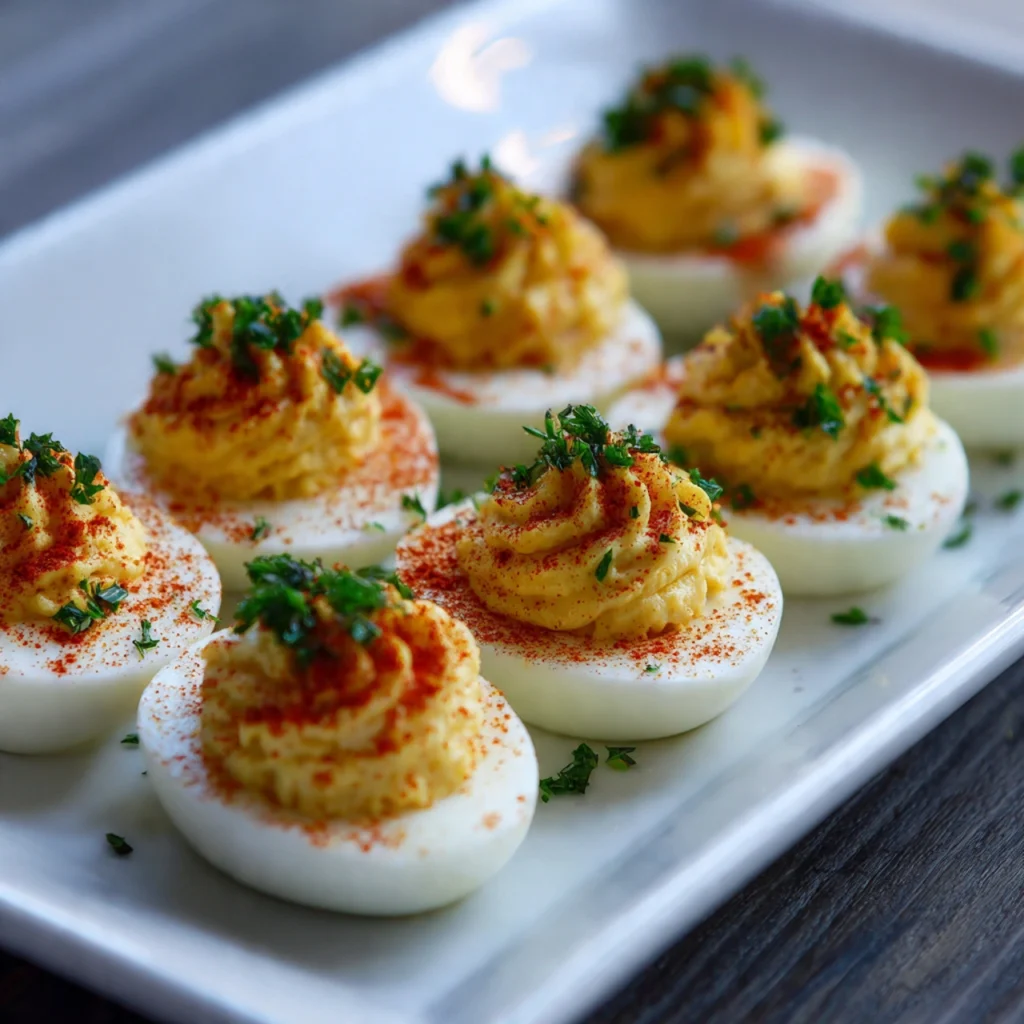
Common Mistakes to Avoid
Mistake #1: Using Too-Fresh Eggs
The single most common reason for difficult peeling is using eggs that are too fresh. Eggs straight from the farm or bought today will have a low pH that causes the membrane to stick stubbornly to the whites, resulting in torn, pockmarked egg white halves.
The fix: Buy your eggs 7-10 days before you plan to make deviled eggs. Store them in the refrigerator and check the date code. Eggs that are approaching their sell-by date are actually ideal for hard boiling.
Mistake #2: Overcooking the Eggs
Overcooked eggs have rubbery whites, chalky dry yolks, and that unattractive green-gray ring. They’re also harder to peel and produce inferior filling.
The fix: Set a timer for exactly 12 minutes of standing time after the water boils. Don’t guess. Immediately ice bath when time is up.
Mistake #3: Skipping the Ice Bath
Some people think they can just run their eggs under cold water for a minute. This doesn’t cool them fast enough, leading to overcooking and difficult peeling.
The fix: Prepare your ice bath before the eggs finish cooking. Transfer eggs immediately and let them sit for at least 5 minutes. The temperature shock is essential.
Mistake #4: Not Tasting the Filling
Many people follow the recipe exactly and don’t taste before filling. Then they end up with bland or overly tangy deviled eggs because every batch of yolks is slightly different.
The fix: Always taste your filling and adjust. Add salt, acid, or mayo in small increments until the flavor is perfect. The filling should taste bold and well-seasoned.
Mistake #5: Making the Filling Too Thin
Runny filling slides off the egg whites, looks messy, and disappoints. This happens from too much mayo, vinegar, or moisture from not drying the yolks.
The fix: Start with less liquid than you think you need. You can always add more. Pat yolks completely dry before mashing. The filling should hold soft peaks.
Mistake #6: Overfilling the Eggs
While generous filling seems appealing, overstuffed deviled eggs are difficult to eat elegantly, unstable on the platter, and the filling-to-white ratio becomes overwhelming.
The fix: Use about 1-1.5 tablespoons of filling per half. The filling should be mounded but not toppling over.
Mistake #7: Not Refrigerating Before Serving
Serving deviled eggs immediately after making them means the filling is still warm, the flavors haven’t melded, and they’re more likely to be messy.
The fix: Always refrigerate for at least 30 minutes (preferably 1-2 hours) before serving. This firms up the filling and improves flavor.
Storage and Serving Suggestions
Refrigerator Storage
Deviled Eggs are best stored properly to maintain quality and food safety:
Assembled eggs: Store assembled deviled eggs in a single layer in an airtight container or covered with plastic wrap for up to 2 days in the refrigerator. Don’t stack them or the filling will smear.
Deviled egg carriers: These specialized containers with individual egg-shaped depressions are perfect for storage and transport. They keep eggs stable and prevent the filling from getting damaged.
Prevent drying: The filling can dry out and crack if exposed to air. Make sure your storage container is airtight, or press plastic wrap directly onto the surface of the eggs.
Make-Ahead Strategy
Deviled Eggs are an excellent make-ahead appetizer:
Best approach (up to 24 hours ahead): Cook and peel eggs, make the filling, but store them separately. The night before your event, fill the eggs and refrigerate. Garnish with paprika just before serving for the brightest color.
Alternative (up to 2 days ahead): Fully assemble the eggs and refrigerate. The paprika may darken slightly after a day, but flavor remains excellent.
Filling only: The yolk filling can be made up to 3 days ahead and stored in an airtight container. Bring to room temperature and stir before piping.
Transport Tips
Taking deviled eggs to a potluck or party? Here’s how to arrive with perfect eggs:
Deviled egg carrier: Invest in one if you make these regularly—worth every penny.
Muffin tin method: Place eggs in a muffin tin (they fit perfectly), cover with plastic wrap, then with foil. Very stable for transport.
Egg carton trick: Clean egg cartons work surprisingly well for transporting. Line with lettuce leaves, place eggs in the depressions.
Keep cold: Transport in a cooler with ice packs, especially in warm weather. Deviled eggs are perishable.
Serving Suggestions
Deviled Eggs are versatile party food:
Classic presentation: Arrange on a serving platter in concentric circles or neat rows. Garnish with paprika and fresh herbs just before serving.
Deviled egg platter: Special platters with egg-shaped indentations keep eggs stable and look elegant.
Garnish stations: For casual gatherings, set out eggs with bowls of various toppings (bacon bits, chives, hot sauce, capers) so guests can customize.
Pairing suggestions: Serve alongside crackers, cheese, crudités, or other cold appetizers. They’re perfect for brunch, Easter dinner, summer picnics, or holiday buffets.
How Many to Make
Portion planning:
- Cocktail party/heavy apps: 2-3 halves per person
- Party with other appetizers: 1-2 halves per person
- Side dish at dinner: 2-3 halves per person
- Potluck contribution: 24-48 halves (2-4 dozen eggs)
Pro tip: Always make more than you think you need. Deviled eggs disappear fast, and you don’t want to run out. Leftovers are never a problem—they store well and make great snacks.
Freezing (Not Recommended)
While hard-boiled egg whites can technically be frozen, I strongly advise against freezing Deviled Eggs. The mayonnaise-based filling doesn’t freeze well (it separates and becomes watery), and the egg whites become rubbery and weep moisture when thawed. Always make these fresh or refrigerate for short-term storage only.
FAQ (Frequently Asked Questions)
1. Why are they called “deviled” eggs?
The term “deviled” in cooking refers to foods that are spicy, zesty, or highly seasoned, and it dates back to the 18th century. The word came from the association between spicy food and the heat of hell/the devil. While deviled eggs aren’t particularly spicy by modern standards, they were considered boldly seasoned compared to plain hard-boiled eggs when the term originated. The mustard, vinegar, and pepper made them “devilishly” flavorful. The term “deviled” is also used for deviled ham, deviled chicken, and other boldly seasoned dishes. Some people prefer to call them “stuffed eggs,” “dressed eggs,” or “salad eggs” if they’re uncomfortable with the term “deviled,.
2. How do I prevent my deviled eggs from sliding around on the platter?
Sliding, wobbly deviled eggs are frustrating and can lead to filling-side-down disasters. Several solutions work well: use a deviled egg platter with individual indentations designed to hold each egg half securely—these are inexpensive and worth having if you make deviled eggs regularly. Alternatively, create a bed of lettuce leaves on a regular platter—the slight texture helps grip the eggs and looks attractive. You can also pipe a tiny dot of filling on the platter before placing each egg white—this acts as “glue.” Another option is to slice a very thin piece off the bottom of each egg white half to create a flat, stable base. Finally, ensure you’re not overfilling the eggs—top-heavy eggs.
3. Can I make deviled eggs without mayonnaise?
Absolutely! While traditional Deviled Eggs use mayonnaise as the creamy base, there are several excellent alternatives. Greek yogurt (full-fat for best results) creates a lighter, tangier filling with extra protein—use the same amount as you would mayo. Sour cream produces a similar creamy texture with pronounced tang. Avocado creates a smooth, creamy filling that’s naturally green—mash very ripe avocado and mix with mustard, lime juice, and seasonings. Cream cheese (softened) makes an incredibly rich, thick filling—you may need to thin it with a bit of milk or pickle juice. Cottage cheese (blended until smooth) offers a high-protein, lower-fat option. Hummus creates a unique Mediterranean-style deviled egg.
4. Why do my deviled eggs taste bland?
Bland deviled eggs are usually the result of underseasoning. Remember that the egg whites are quite bland, so the filling needs to be boldly seasoned to compensate. The most common culprits are: insufficient salt—don’t be shy, taste the filling and keep adding small pinches of salt until the flavors pop. Not enough acid—the vinegar or lemon juice is essential for brightness and should be clearly present. Weak or insufficient mustard—mustard provides depth and tang; using too little or a very mild variety results in flat flavor. Not tasting and adjusting—every batch of yolks is slightly different, so you must taste your filling before piping and adjust seasonings. To fix bland deviled eggs.
5. How long can deviled eggs sit out at a party?
Food safety is important with deviled eggs since they contain both eggs and mayonnaise, both of which are perishable. According to USDA guidelines, deviled eggs should not sit at room temperature for more than 2 hours total. If the ambient temperature is above 90°F, that time limit drops to just 1 hour. After this time, harmful bacteria can multiply to unsafe levels. To keep deviled eggs safe at longer parties: use a cold platter, replace the eggs from refrigerated batches every 1-2 hours, keep backup batches cold and bring out fresh platters as needed, or use an ice-filled bowl underneath your serving platter to keep eggs chilled. For outdoor events, keep deviled eggs.
6. Can I use a hand mixer or food processor to make the filling?
Yes, and in fact, using electric mixing tools creates the smoothest, most professional-quality filling! A hand mixer works beautifully—place your yolks and other filling ingredients in a bowl and beat on medium speed for 30-60 seconds until completely smooth and fluffy. This creates an incredibly light, creamy texture with zero lumps. A food processor is even more effective—pulse the yolks with the other ingredients for 30-45 seconds until silky smooth. The food processor creates the finest, most luxurious texture possible. If using either method, scrape down the sides of the bowl partway through to ensure everything is evenly incorporated. But if you’re making deviled eggs for a large party.
7. What’s the best way to transport deviled eggs without ruining them?
Transporting Deviled Eggs can be tricky, but with the right approach, they’ll arrive perfect. The best option is a deviled egg carrier—these plastic containers have individual depressions that hold each egg half securely, preventing sliding and smashing. They come in various sizes and are inexpensive. If you don’t have a carrier, use a muffin tin—regular-sized muffin cups fit egg halves perfectly. Place eggs in the tin, cover tightly with plastic wrap, then cover again with aluminum foil. This is surprisingly stable. Another option is a clean egg carton—line it with lettuce leaves, place eggs in the individual cups. Don’t place heavy items on top of your deviled eggs.
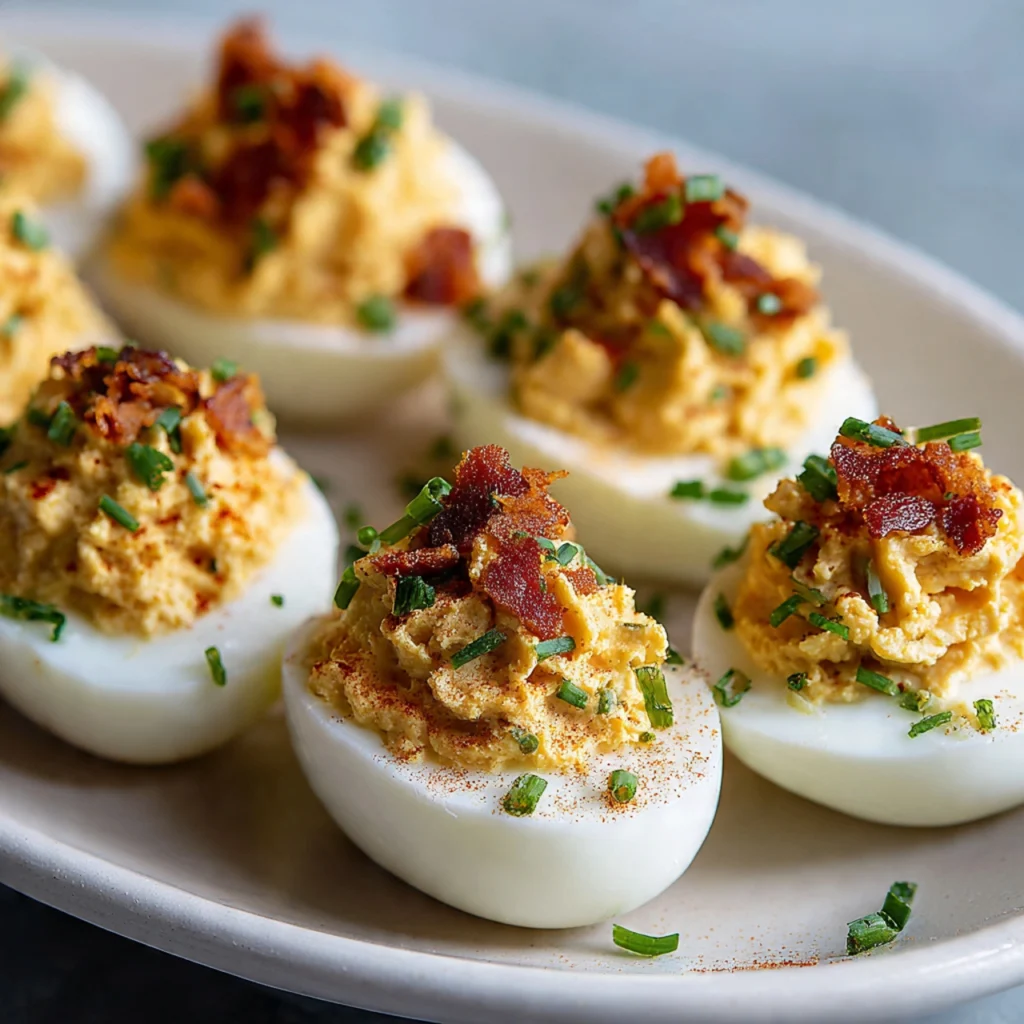
Nutrition Information (Approximate Values)
Serving Size: 2 deviled egg halves (1 whole egg)
Servings Per Recipe: 6 (from 6 eggs/12 halves)
Calories: 130-140 kcal
Total Fat: 11g
- Saturated Fat: 3g
- Trans Fat: 0g
Cholesterol: 215mg (72% DV)
Sodium: 180mg (8% DV)
Total Carbohydrates: 1g
- Dietary Fiber: 0g
- Sugars: 0.5g
Protein: 7g
Vitamin D: 1.2mcg (6% DV)
Calcium: 30mg (2% DV)
Iron: 1mg (6% DV)
Potassium: 75mg (2% DV)
Vitamin A: 90mcg (10% DV)
Vitamin B12: 0.6mcg (25% DV)
Choline: 147mg (27% DV)
Additional Micronutrients:
- Excellent source of high-quality protein (contains all essential amino acids)
- Good source of Vitamin B12 (important for nerve function and red blood cell formation)
- Good source of choline (important for brain health and development)
- Contains selenium (antioxidant mineral)
- Provides riboflavin (Vitamin B2)
- Contains healthy fats (primarily from egg yolks and mayonnaise)
Notes on Nutrition:
- Most calories and nutrients come from the egg yolks
- Cholesterol content is high, but dietary cholesterol has less impact on blood cholesterol than previously thought for most people
- Using reduced-fat mayo can reduce calories by approximately 20-30 per serving
- Adding bacon, cheese, or other mix-ins will increase calories, fat, and sodium
- Deviled eggs are naturally low in carbohydrates
- The protein content makes them relatively satiating despite small size
- Naturally gluten-free
- Not suitable for vegan diets (contains eggs)
Final Thoughts
These Deviled Eggs represent the perfect balance of simplicity and sophistication—a recipe that seems humble yet always impresses, requires minimal ingredients yet delivers maximum flavor, and looks elegant enough for the fanciest occasions while being easy enough for weeknight snacking.
What I love most about this recipe is its reliability. Unlike some dishes that turn out differently each time depending on variables you can’t control, this method produces consistent. Follow the timing precisely, use the ice bath without skipping, taste and adjust your filling, and you’ll have deviled eggs that rival anything from a gourmet caterer.
Over the years, I’ve made these for countless gatherings—holiday dinners where they disappeared within minutes, baby showers where guests requested the recipe, potlucks where my platter came home spotless while others went home with leftovers, and casual family get-togethers where even the pickiest eaters reached for seconds.
The beauty of Deviled Eggs lies not just in their deliciousness but in their versatility. They work equally well as an elegant passed appetizer at a cocktail party, a casual contribution to a backyard barbecue, a protein-packed snack, or a nostalgic addition to holiday tables.
I encourage you to make this recipe your own. Once you master the basic technique, experiment with the variations—try bacon and chive, spicy sriracha, or herbaceous dill. Adjust the tang level to your preference. Deviled Eggs are too delicious to make only once or twice a year.
Here’s to the recipes that bring people together, to the appetizers that disappear first, and to the simple pleasures of perfectly executed classics. May your eggs always peel beautifully, your filling be forever creamy, and your platters return home empty.
Make them with care, serve them with pride, and enjoy every creamy, tangy bite!
PrintDeviled Eggs: The Classic Recipe with 7 Pro Secrets (20 Minutes)
Classic Deviled Eggs are the perfect party appetizer—creamy, tangy, and absolutely irresistible. This foolproof recipe produces perfectly cooked eggs that peel effortlessly, with a smooth, well-seasoned filling that’s neither too rich nor too tangy. Whether you’re making them for Easter brunch, a summer picnic, holiday gatherings, or potluck parties, these elegant little bites disappear faster than any other appetizer on the table. Ready in just 20 minutes with simple ingredients you likely already have in your kitchen.
- Prep Time: 8 minutes
- Cook Time: 12 minutes (plus ice bath time)
- Total Time: 20 minutes (plus 30 minutes chilling)
- Yield: 6 servings (12 deviled egg halves)
- Category: Appetizer, Snack, Party Food, Finger Food
- Method: Boiling, Mixing
- Cuisine: American, Southern
- Diet: Gluten Free
Ingredients
For the Eggs:
- 6 large eggs (preferably 7-10 days old)
- Water (enough to cover eggs by 1 inch)
- Ice bath (bowl filled with ice and cold water)
For the Filling:
- 3 tablespoons mayonnaise (Duke’s or Hellmann’s recommended)
- 1½ teaspoons Dijon mustard
- 1½ teaspoons white vinegar
- ¼ teaspoon fine sea salt (adjust to taste)
- ⅛ teaspoon black pepper (freshly ground)
- Pinch of cayenne pepper (optional)
For Garnish:
- Paprika (sweet, smoked, or Hungarian)
- Fresh chives or parsley (finely chopped, optional)
Instructions
- Cook eggs: Place eggs in a single layer in a saucepan. Cover with cold water by 1 inch. Bring to a full rolling boil over high heat. Immediately remove from heat, cover with lid, and let stand exactly 12 minutes.
- Ice bath: Prepare ice bath while eggs cook. Transfer cooked eggs immediately to ice bath. Let sit for at least 5 minutes (10 minutes is better) until completely cold.
- Peel eggs: Gently tap eggs all over to crack shells. Starting from the wider end, peel under running water or in a bowl of water. The shell should come off easily in large pieces. Pat eggs dry with paper towels.
- Halve and remove yolks: Slice each egg lengthwise in half with a sharp knife (wipe clean between cuts). Carefully remove yolks and place in a medium bowl. Arrange egg white halves on a serving platter.
- Make filling: Add mayonnaise, Dijon mustard, vinegar, salt, pepper, and cayenne to the yolks. Mash with a fork until relatively combined, then whisk or beat with a hand mixer for 30-60 seconds until completely smooth and creamy. Taste and adjust seasonings as needed.
- Fill eggs: Transfer filling to a piping bag with a star tip (or use a spoon). Pipe or spoon filling into each egg white half, using about 1-1.5 tablespoons per half.
- Garnish and chill: Lightly sprinkle each egg with paprika. Add fresh herbs if desired. Cover loosely with plastic wrap and refrigerate for at least 30 minutes (up to 24 hours) before serving.
Notes
- Egg freshness: Use eggs that are 7-10 days old for easiest peeling. Very fresh eggs are difficult to peel.
- Cooking alternatives: Steam eggs for 12 minutes, or pressure cook for 5 minutes with 5-minute natural release for even easier peeling.
- Consistency: Filling should be thick enough to hold its shape when piped but still creamy. Add mayo to thin or extra yolk to thicken.
- Make-ahead: Can be made up to 24 hours in advance. Store covered in refrigerator.
- Variations: Add pickle relish, bacon, hot sauce, herbs, or other mix-ins to customize.
- Storage: Store in airtight container for up to 2 days. Don’t leave at room temperature for more than 2 hours.