Introduction
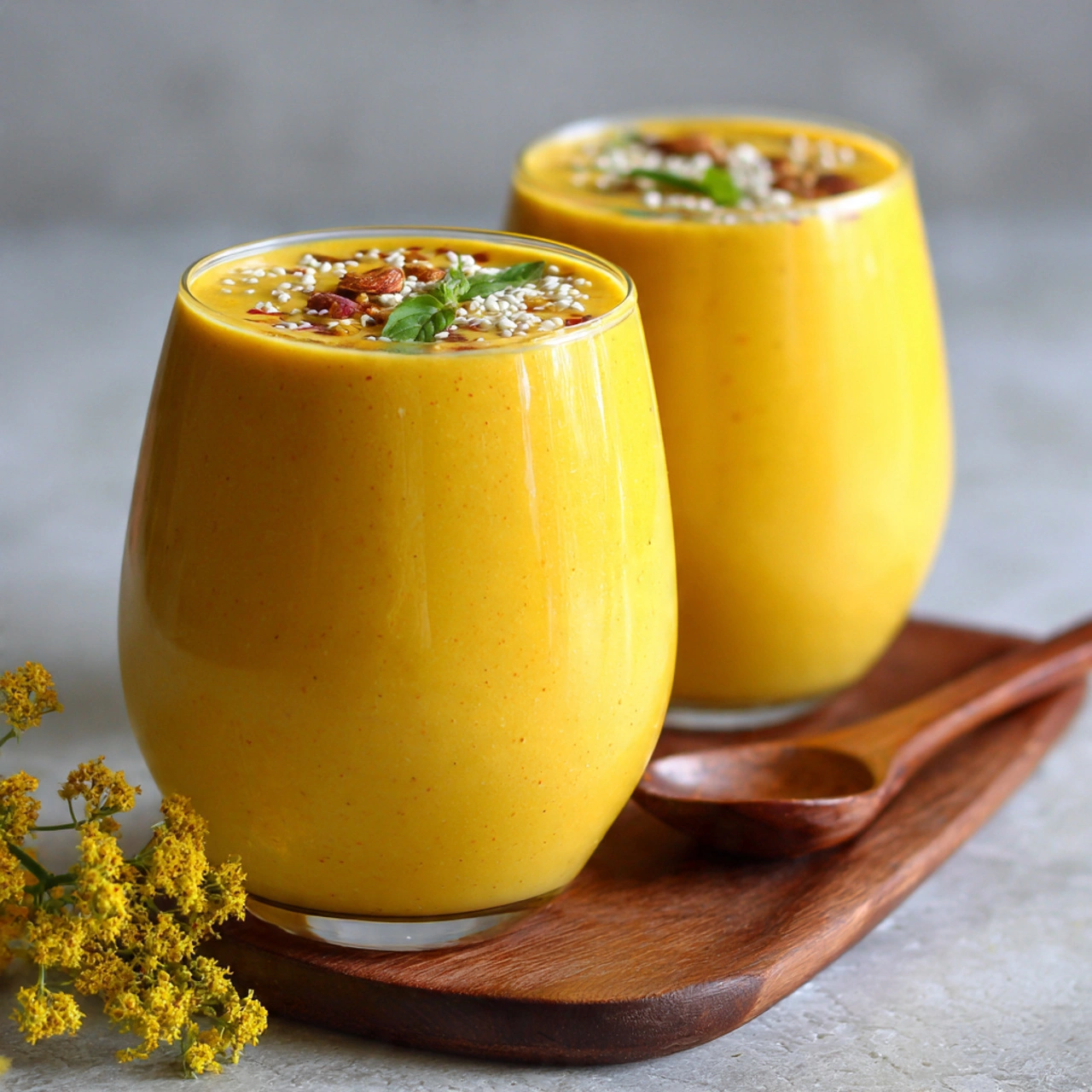
A Mango Coconut Milk Smoothie is hands down the most luxurious way to start your morning—imagine thick, velvety coconut cream swirled together with sweet, sunshine-colored mango in a drink so rich and satisfying it feels like dessert, yet it’s completely guilt-free and packed with nutrients. This isn’t just another fruit smoothie; it’s a tropical vacation captured in a glass, delivering the kind of creamy indulgence you’d expect from a milkshake while remaining completely dairy-free, naturally sweetened, and wholesome enough to serve as a nourishing breakfast.
My obsession with this particular smoothie combination started during a trip to Kerala, India, where I stayed at a small beachside guesthouse. Every morning, the owner would blend fresh mangoes with homemade coconut milk extracted from coconuts grown right there on the property.
After returning, I spent months perfecting this recipe, testing different types of coconut milk, various mango varieties, and countless ratios until I landed on the formula I’m sharing with you today. What makes this Mango Coconut Milk Smoothie exceptional is the perfect balance between rich, fatty coconut and bright, fruity mango—neither overwhelms the other.
This recipe has become my go-to for impressing guests at brunch, for sneaking nutrition into my kids’ diets (they think it’s a special treat), and for those mornings when I need something substantial but don’t have the appetite for solid food. It works equally well as a post-workout recovery drink, an afternoon energy boost, or even a healthy dessert alternative that won’t derail your wellness goals.
Whether you’re vegan, lactose intolerant, trying to eat more plant-based meals, or simply someone who appreciates the combination of coconut and mango, this smoothie will become a staple in your kitchen. Let’s dive into creating this absolutely divine tropical drink that tastes like pure sunshine.
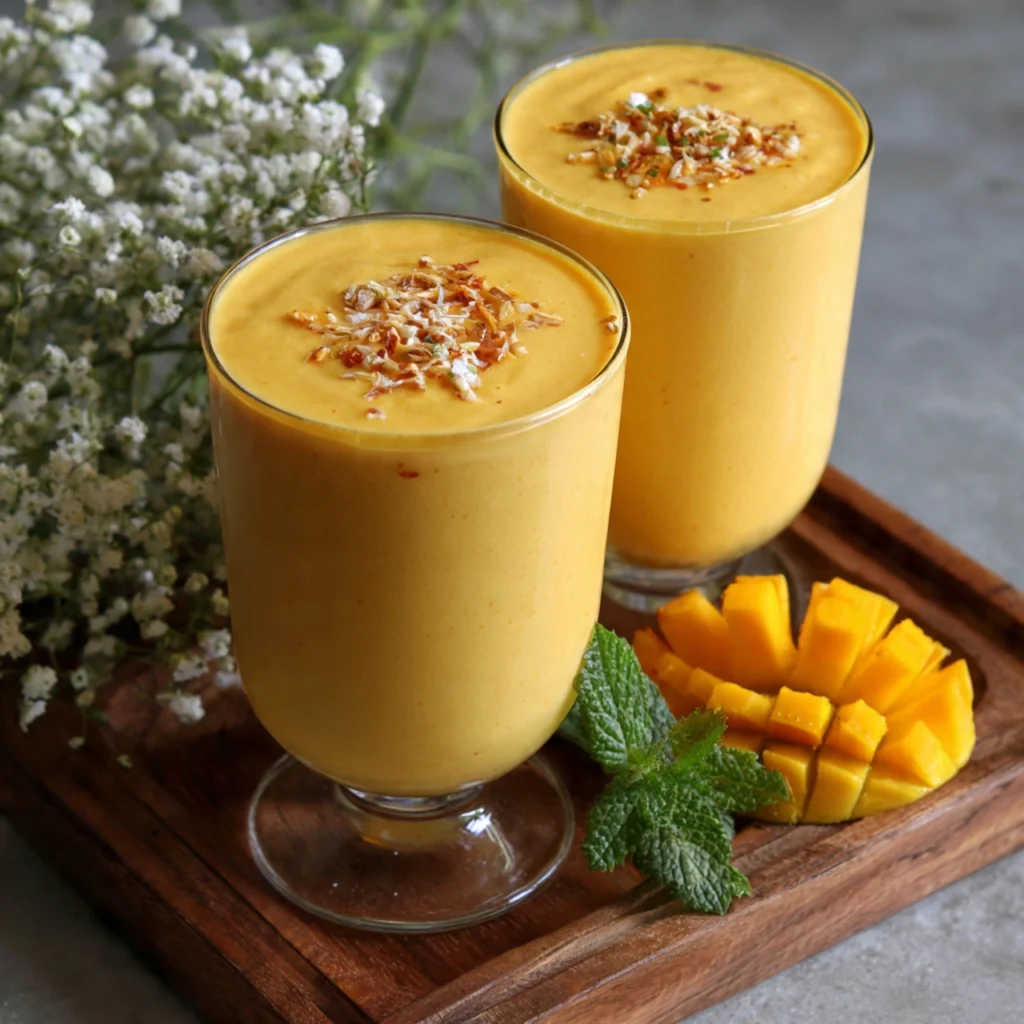
Ingredients For Mango Coconut Milk Smoothie
For the Classic Mango Coconut Milk Smoothie:
- 2 cups ripe mango chunks (fresh or frozen, about 300g) – provides natural sweetness and gorgeous golden color
- 1 cup full-fat coconut milk (from a can, well-stirred) – creates that signature rich, creamy texture
- ½ cup coconut water (or regular water) – thins to perfect drinkable consistency
- 1-2 tablespoons maple syrup or agave nectar (optional, depending on mango sweetness)
- ½ cup ice cubes (about 4-5 cubes; reduce or omit if using frozen mango)
- 1 teaspoon fresh lime juice – brightens all the flavors and adds complexity
Optional Flavor Enhancers:
- ½ frozen banana – adds extra creaminess and natural sweetness
- 2 tablespoons coconut cream (the thick part from the top of the can) – makes it even richer
- 1 tablespoon shredded coconut (sweetened or unsweetened) – intensifies coconut flavor
- ¼ teaspoon vanilla extract – adds warmth and depth
- Pinch of ground cardamom – traditional Indian spice that pairs beautifully with mango
- ½ teaspoon fresh grated ginger – adds a subtle spicy kick
- 1 tablespoon chia seeds – boosts omega-3s and fiber
- 1 scoop vanilla plant-based protein powder – transforms it into a high-protein meal
- Handful of spinach – adds nutrients without affecting the tropical taste
- ¼ teaspoon turmeric powder – anti-inflammatory boost with minimal flavor impact
Best Mango Varieties for This Smoothie:
- Alphonso (Hapus) – the king of mangoes, intensely sweet and creamy
- Ataulfo (Honey Mango) – buttery smooth, less fibrous, perfect for blending
- Kent – large, sweet, and exceptionally juicy
- Haden – rich flavor with vibrant color
- Keitt – sweet with low acidity, blends beautifully
Coconut Milk Options:
- Full-fat canned coconut milk – BEST option for creamiest results (Thai Kitchen, Native Forest, Trader Joe’s brands)
- Lite coconut milk – lower calories but less creamy; increase to 1.25 cups for proper consistency
- Coconut cream – ultra-rich; use ½ cup coconut cream plus ½ cup coconut water
- Carton coconut milk – NOT recommended; too thin and watery, won’t create proper texture
For Garnishing:
- Fresh mango slices or cubes
- Toasted coconut flakes
- Fresh mint sprigs
- Lime wheel
- Edible flowers (hibiscus, orchid)
- Drizzle of coconut cream
Step-by-Step Instructions
Step 1: Prepare Your Coconut Milk (1 minute)
This step is crucial for achieving the perfect creamy consistency. Canned coconut milk naturally separates during storage, with the thick coconut cream rising to the top and the watery liquid settling at the bottom. Before opening your can, shake it vigorously for 15-20 seconds. If you forgot to shake it beforehand, open the can and use a whisk or fork to thoroughly combine the cream and liquid until completely smooth and uniform.
For the absolute creamiest Mango Coconut Milk Smoothie, refrigerate your can of coconut milk overnight. The next day, open it and scoop out only the thick cream from the top (about ¾ cup), reserving the liquid for another use. This creates an incredibly rich, almost ice-cream-like smoothie that’s pure decadence.
Temperature tip: Room temperature coconut milk blends more easily than cold. If your coconut milk is refrigerated and has solidified, let the can sit at room temperature for 10-15 minutes, or run it under warm water for a minute to soften before opening.
Step 2: Prepare Your Mangoes (1 minute)
If you’re using fresh mangoes, you’ll need to peel and cube them. Stand the mango vertically on your cutting board with the stem facing up. The pit is flat and oval-shaped, running through the center. Slice down along one side of the pit, removing a large “cheek” of fruit. Repeat on the opposite side. You now have two large mango pieces plus the center with the pit.
For the cheeks, score the flesh in a crosshatch pattern without cutting through the skin, creating a grid of cubes. Invert the skin so the cubes pop outward, then slice them off into your blender. For the remaining fruit around the pit, carefully cut away strips of mango flesh.
If you’re using frozen mango chunks (my preferred method for year-round convenience), simply measure them out and let them sit at room temperature for 2-3 minutes. Slightly softened frozen mango blends more smoothly and creates less strain on your blender motor.
Ripeness check: Taste a piece of mango before blending. Perfectly ripe mango is sweet and requires minimal or no additional sweetener. Slightly underripe mango will need the full amount of maple syrup.
Step 3: Layer Ingredients Strategically (30 seconds)
The order you add ingredients to your blender makes a significant difference in achieving a lump-free, perfectly smooth result. Always start with liquids at the bottom—this creates the vortex effect that pulls solid ingredients down toward the blades.
First, pour in your coconut milk and coconut water. Add the lime juice and maple syrup (if using). These liquids form the base layer that allows your blender to do its job efficiently.
Next, add your mango chunks. If you’re including optional ingredients like banana, chia seeds, or spinach, layer them on top of the mango. Finally, add your ice cubes last. The weight of the ice helps push everything down toward the blades.
Blender tip: If you’re using a less powerful blender, cut your mango chunks into smaller pieces before adding them. This prevents your blender motor from struggling and ensures a smoother final texture.
Step 4: Blend to Silky Perfection (1-2 minutes)
Start your blender on the lowest speed setting for 15-20 seconds. You’ll hear the ice and frozen fruit beginning to break down, and the sound will change from loud crunching to a smoother whirring. This gentle start protects your blender motor and prevents ingredients from flying up and sticking to the sides without being blended.
After this initial phase, increase to medium speed for 20-30 seconds. If your blender has a tamper tool, use it to push stubborn chunks down toward the blades. If not, you may need to stop the blender, remove the lid, and use a spatula to scrape down the sides and redistribute ingredients toward the bottom.
Finally, increase to the highest speed setting and blend for 45-60 seconds until the smoothie is completely uniform—no ice crystals, no mango chunks, no streaks of separated coconut cream. The final texture should be thick, smooth, and pourable, similar to a milkshake or soft-serve ice cream.
Texture check: The Mango Coconut Milk Smoothie should coat the back of a spoon and have a luxurious, creamy mouthfeel. If you see any white specks (ice) or orange chunks (mango), blend for another 15-20 seconds.
Step 5: Taste and Perfect (30 seconds)
This critical step ensures every smoothie you make is absolutely delicious. Pour a small amount into a glass and taste it. Evaluate both flavor and consistency:
Too thick? Add coconut water or coconut milk, one tablespoon at a time, blending for 10 seconds after each addition.
Too thin? Add more frozen mango, a few ice cubes, or a spoonful of coconut cream and blend again.
Not sweet enough? Drizzle in maple syrup or agave, starting with one teaspoon and blending briefly. Remember that cold temperatures suppress sweetness perception, so your smoothie will taste slightly sweeter as it warms to drinking temperature.
Too sweet? Add a squeeze of fresh lime juice—acid balances sweetness beautifully and makes the mango flavor more vibrant.
Needs more coconut flavor? Add a tablespoon of shredded coconut or coconut cream and blend for 10 seconds.
Flat or one-dimensional? A tiny pinch of salt (1/16 teaspoon) can round out flavors and make everything taste more pronounced.
Step 6: Serve with Style (30 seconds)
Pour your Mango Coconut Milk Smoothie into a chilled glass for the most refreshing experience. For an elevated presentation worthy of a tropical resort, rim your glass with shredded coconut (dip the rim in maple syrup first, then press into coconut flakes) before pouring.
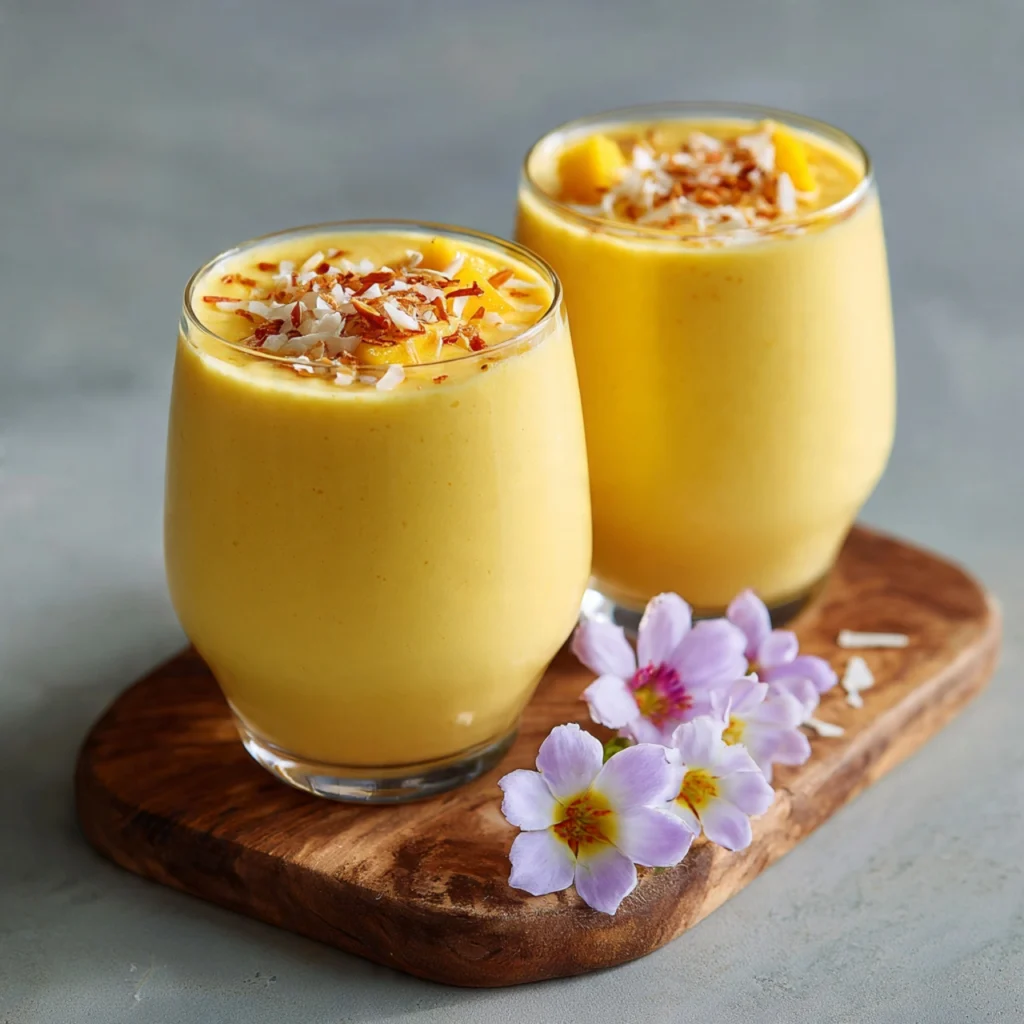
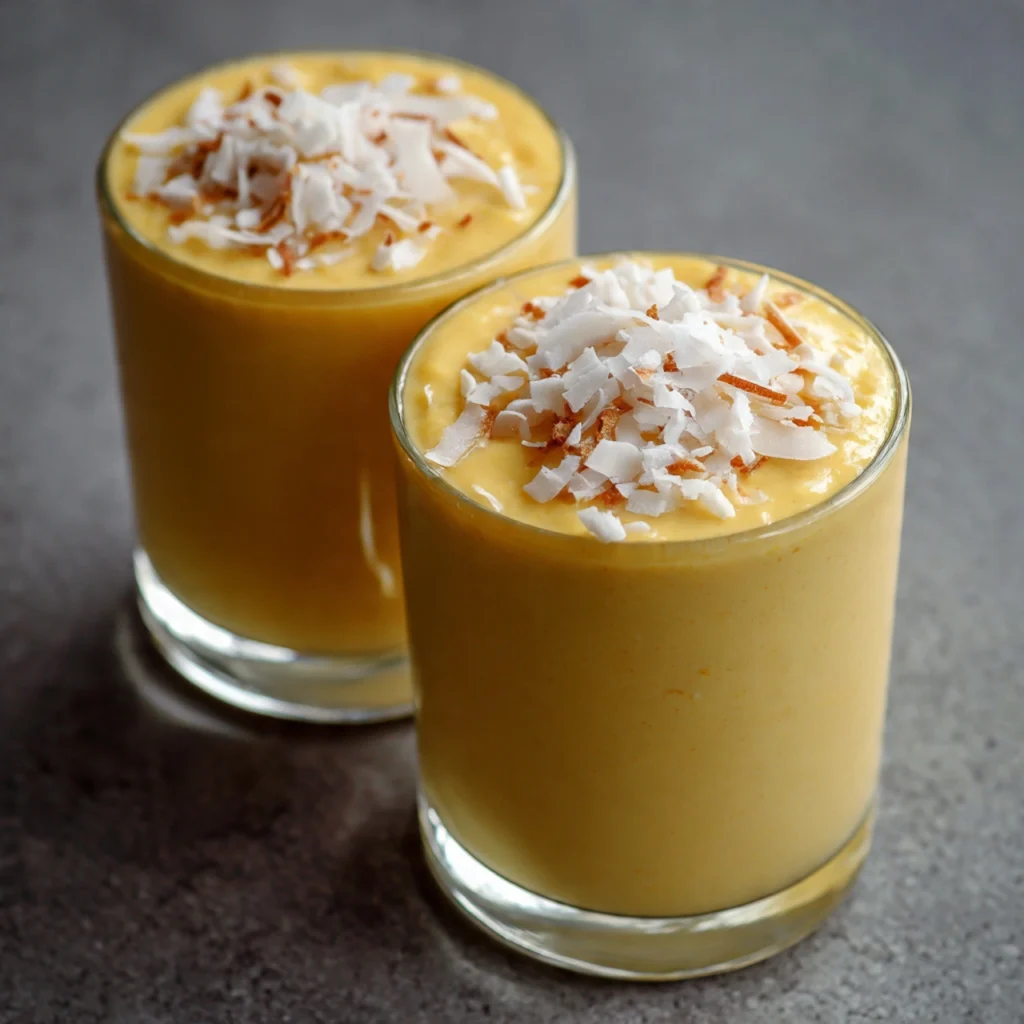
Garnish with a fresh mango slice perched on the rim, a sprinkle of toasted coconut flakes on top, and a sprig of fresh mint. A lime wheel adds a pop of green color that contrasts beautifully with the golden-orange smoothie.
Serve immediately with a thick reusable straw or a long spoon if it’s particularly thick. This smoothie is best enjoyed within 10-15 minutes of blending, when the texture is at its peak and the temperature is perfectly icy-cold.
Pro Tips for the Perfect Mango Coconut Milk Smoothie
Choosing the Right Coconut Milk
Not all coconut milk is created equal, and your choice dramatically impacts the final result. Full-fat canned coconut milk is non-negotiable for the creamiest, most authentic Mango Coconut Milk Smoothie. The fat content (typically 17-19% for full-fat varieties) creates that luxurious, rich mouthfeel that makes this smoothie special.
Avoid the coconut milk sold in cartons in the refrigerated section (usually labeled “coconut milk beverage”)—these are heavily diluted with water and contain gums, stabilizers, and minimal actual coconut. They’ll produce a thin, disappointing smoothie that tastes more like flavored water than a tropical indulgence.
Brand recommendations: Thai Kitchen, Native Forest, Trader Joe’s, and Natural Value all produce excellent full-fat coconut milk with minimal additives. Look for cans that list coconut extract and water as the only ingredients, with possibly guar gum as a stabilizer.
Separation is normal: Quality coconut milk separates in the can. This is actually a good sign—it means there are minimal emulsifiers and you’re getting pure coconut. Just shake or whisk before using.
Fresh vs. Frozen Mango Strategy
I genuinely prefer frozen mango for this Mango Coconut Milk Smoothie recipe because it creates the ideal thick, frosty texture without diluting flavor with ice. Frozen mango is typically harvested at peak ripeness and flash-frozen, which often makes it sweeter and more consistent than fresh mango from the grocery store.
Additionally, frozen mango eliminates prep work (already peeled and cubed), is available year-round regardless of season, and is often more economical than fresh, especially outside of peak mango season.
That said, fresh mango during peak season (late spring through summer) offers unbeatable flavor intensity and aroma. If using fresh mango, you must add ice to achieve the proper frosty consistency—use about ¾ cup ice cubes.
Best of both worlds: Use 1.5 cups frozen mango plus ½ cup fresh mango. This balances optimal texture (from frozen) with peak flavor (from fresh).
The Lime Juice Secret
Just one teaspoon of fresh lime juice transforms this smoothie from good to extraordinary. Lime provides brightness and acidity that cuts through the richness of coconut milk and enhances the mango’s natural sweetness. Without it, the smoothie can taste flat, one-dimensional, or overly sweet.
Think of lime juice as you would salt in cooking—it’s the seasoning that makes all other flavors sing. The lime shouldn’t be identifiable as a distinct flavor; it should simply make the mango taste more vibrant and the coconut more pronounced.
Always use fresh lime juice, never bottled. Fresh lime has essential oils and complexity that bottled versions lack. One medium lime yields about 2 tablespoons of juice, enough for several smoothies.
Achieving the Perfect Thickness
Texture preference is highly personal—some people love a thick, spoonable smoothie bowl consistency, while others prefer something they can easily sip through a straw. Here’s how to customize:
For extra-thick, ice-cream-like texture:
- Use only frozen mango (no fresh)
- Reduce liquid to ¼ cup coconut water
- Add 2 tablespoons coconut cream
- Include ½ frozen banana
- Skip ice cubes entirely
For medium-thick, classic smoothie texture (recommended):
- Follow recipe as written
- Use combination of frozen mango and ice
Thinner, more drinkable consistency:
- Increase coconut water to ¾ cup
- Use only ½ cup ice
- Let smoothie sit for 2-3 minutes before drinking
For smoothie bowl:
- Reduce coconut water to ¼ cup
- Use 2.5 cups frozen mango
- Blend until thick and spoonable
- Top with granola, fresh fruit, coconut flakes, and seeds
Boosting Nutritional Value
While this Mango Coconut Milk Smoothie is already nutritious (rich in vitamins A and C, healthy fats, and minerals), you can enhance it further:
Protein boost: Add plant-based protein powder (vanilla or unflavored works best), 2 tablespoons of hemp hearts, or ¼ cup of silken tofu (adds creaminess plus protein).
Healthy fats: Include 1 tablespoon of almond butter, cashew butter, or tahini for sustained energy and satiety.
Fiber increase: Add 1 tablespoon of chia seeds or ground flaxseed. Let smoothie sit for 5 minutes after blending to allow seeds to hydrate and thicken.
Greens addition: A generous handful of spinach or kale blends invisibly, masked by the strong mango-coconut flavor. The smoothie might turn slightly more golden-green, but you won’t taste the vegetables.
Anti-inflammatory boost: Add ¼ teaspoon turmeric powder and a tiny pinch of black pepper (enhances turmeric absorption) for immune support.
Probiotic support: Add 2-3 tablespoons of dairy-free yogurt (coconut or almond yogurt) for gut health benefits.
Sweetener Considerations
The need for sweetener depends entirely on your mango’s ripeness. Perfectly ripe, in-season mangoes are often sweet enough that you won’t need any additional sweetener at all. However, out-of-season, slightly underripe, or naturally less sweet mango varieties may need help.
Natural sweetener options:
- Maple syrup – my top choice; adds depth without competing with mango
- Agave nectar – neutral flavor, dissolves easily
- Medjool dates (1-2 pitted) – whole food sweetener with fiber
- Coconut sugar – subtle caramel notes that complement tropical flavors
- Frozen banana – adds sweetness plus extra creaminess
Sugar-free options:
- Liquid stevia (2-3 drops)
- Monk fruit sweetener
- Erythritol (if tolerated)
My approach: Taste your mango first. If it’s deliciously sweet on its own, skip sweetener entirely. If it’s tart or bland, start with 1 tablespoon of maple syrup and adjust after blending.
Coconut Flavor Intensity
Some people love intense coconut flavor, while others prefer it more subtle with mango taking center stage. Here’s how to adjust:
For stronger coconut flavor:
- Use coconut cream instead of coconut milk
- Add 1-2 tablespoons shredded coconut
- Replace coconut water with coconut milk
- Add ¼ teaspoon coconut extract
- Top with toasted coconut flakes
For milder coconut flavor:
- Use lite coconut milk
- Replace some coconut milk with almond or oat milk
- Increase coconut water and reduce coconut milk
- Add extra mango for more fruit-forward flavor
Common Mistakes to Avoid For Mango Coconut Milk Smoothie
Mistake #1: Using Carton Coconut Milk
The single biggest mistake people make with this recipe is substituting canned coconut milk with the watery coconut milk sold in cartons. These products are entirely different—carton coconut milk is 90-95% water with minimal coconut content, designed as a milk alternative for cereal or coffee, not for creating creamy smoothies.
The fix: Always use full-fat canned coconut milk. If you absolutely cannot find it, use coconut cream instead (the extra-thick version sold in smaller cans), diluted with a little water or coconut water.
Mistake #2: Not Shaking or Mixing Separated Coconut Milk
Coconut milk separates naturally, and if you pour it into your blender without mixing first, you’ll get clumps of thick coconut cream mixed with watery liquid, creating an uneven, curdled-looking smoothie.
The fix: Always shake the can vigorously before opening, or open it and whisk thoroughly until completely smooth. The coconut milk should be homogeneous before it goes into your blender.
Mistake #3: Adding Too Much Liquid Initially
Many people panic when their blender struggles with frozen fruit and immediately add extra liquid. This creates a thin, watery smoothie that’s disappointing to drink and lacks that creamy, satisfying texture that makes this recipe special.
The fix: Start with the minimum amount of liquid (½ cup coconut water) and add more only if absolutely necessary, one tablespoon at a time. Remember, you can always thin a too-thick smoothie, but you cannot thicken a watery one without adding more fruit.
Mistake #4: Using Old or Rancid Coconut Milk
Coconut milk has a limited shelf life, and expired coconut milk can taste sour, metallic, or off. Additionally, some brands use coconut milk that wasn’t processed at peak freshness, resulting in a grey or yellowish color instead of pure white.
The fix: Check expiration dates before purchasing. Once opened, canned coconut milk lasts only 4-5 days in the refrigerator. Good coconut milk should be bright white (the cream part) and smell fresh and mildly coconut-scented. If it smells sour or looks discolored, discard it.
Mistake #5: Over-Blending
While you want a smooth texture, blending continuously for more than 2-3 minutes can warm up your smoothie from blade friction, causing ice to melt and creating a thin, less refreshing drink. Some blenders generate significant heat during prolonged operation.
The fix: Blend just until smooth with no visible chunks—typically 60-90 seconds total. The smoothie should still be very cold when poured.
Mistake #6: Using Fibrous, Underripe Mangoes
Underripe mangoes are not only tart and flavorless but also extremely fibrous. These fibers don’t break down completely during blending, creating stringy bits that get stuck in your teeth and create an unpleasant texture.
The fix: Only use mangoes that are soft to touch, fragrant, and fully ripe. If your mangoes are underripe, let them ripen at room temperature for 2-4 days before using. In a pinch, add frozen banana to mask the tartness and improve texture.
Mistake #7: Forgetting the Lime Juice
It seems like such a small amount that many people skip it, thinking it won’t make a difference. But that single teaspoon of lime juice is what elevates this from a decent smoothie to an exceptional one—it provides brightness, balances sweetness, and makes all flavors more vivid.
The fix: Don’t skip it! Fresh lime juice is essential to the perfect Mango Coconut Milk Smoothie. If you don’t have lime, lemon works in a pinch, though lime is more traditional with tropical flavors.
Storage and Serving Suggestions For Mango Coconut Milk Smoothie
Immediate Serving (Best Option)
This Mango Coconut Milk Smoothie reaches its absolute peak within 10-15 minutes of blending. The texture is thick and creamy, the temperature is perfect, and all ingredients are fully emulsified for optimal flavor. Pour into a chilled glass and enjoy immediately for the best experience.
Presentation ideas: Serve in a tall glass with a colorful paper straw, garnish with fresh mango and toasted coconut, and add a lime wheel on the rim for that resort-worthy look.
Refrigerator Storage (Up to 8 Hours)
If you need to make this smoothie ahead for later consumption, it stores reasonably well in the refrigerator. Pour into an airtight container or mason jar, filling it to the very top to minimize air exposure (which causes oxidation and separation). Seal tightly and refrigerate for up to 8 hours.
Before drinking, the smoothie will have separated—coconut fat may have risen to the top, and liquid will have settled at the bottom. This is completely normal. Shake vigorously for 20-30 seconds, or pour back into your blender and pulse a few times to recombine. The texture won’t be quite as perfect as fresh, but it’s still delicious.
Morning prep tip: Blend your smoothie the night before, store in the fridge, and shake well in the morning for a quick breakfast.
Freezer Storage (Up to 3 Months)
Mango Coconut Milk Smoothies freeze beautifully, making them perfect for batch preparation. Pour the smoothie into freezer-safe containers or mason jars, leaving about 1 inch of headspace at the top for expansion. Seal tightly and freeze for up to 3 months.
To thaw and serve: Transfer from freezer to refrigerator overnight. In the morning, the smoothie will be partially thawed with a slushy consistency—either drink as-is (very refreshing) or pour into your blender with 2-3 tablespoons of coconut milk and blend for 20 seconds to restore the creamy texture.
Quick-thaw method: Let the frozen smoothie sit at room temperature for 20-30 minutes, break it up with a spoon, then blend with a splash of coconut milk until smooth.
Smoothie Popsicles
Transform your Mango Coconut Milk Smoothie into frozen treats by pouring it into popsicle molds. These make fantastic healthy desserts, especially during summer. Freeze for 4-6 hours or overnight. Store popsicles in the freezer for up to 2 months.
Layered popsicles: Pour half the smoothie into molds, freeze for 1 hour, then add a layer of coconut cream, freeze another hour, then top with more smoothie and freeze completely for a beautiful striped effect.
Smoothie Bowl Transformation
Turn this into a stunning breakfast bowl by using less liquid (reduce coconut water to ¼ cup) for an extra-thick, spoonable consistency. Pour into a bowl and create an artistic arrangement of toppings:
Suggested toppings:
- Fresh mango cubes or slices
- Granola or muesli (coconut granola works perfectly)
- Toasted coconut flakes
- Fresh berries (strawberries, blueberries)
- Sliced banana
- Chia seeds or hemp hearts
- Chopped macadamia nuts or cashews
- Passion fruit pulp
- Edible flowers
- Drizzle of coconut cream or maple syrup
Arrange toppings in sections or artistic patterns for an Instagram-worthy presentation that’s as beautiful as it is nutritious.
Portion Recommendations
This recipe makes approximately 2-2.5 cups (16-20 oz) of smoothie. This is:
- A generous single serving as a meal replacement
- Two smaller servings as a snack or dessert
- One large smoothie bowl with toppings
For children: Split into two 8-10 oz portions For athletes/high protein needs: Use full recipe as post-workout recovery drink For weight management: Enjoy half the recipe (8-10 oz) as a satisfying snack
Mango Coconut Milk Smoothie FAQ (Frequently Asked Questions)
1. Can I make this Mango Coconut Milk Smoothie without any added sweetener?
Absolutely! If your mangoes are perfectly ripe, sweet, and in-season, you likely won’t need any additional sweetener at all. The natural sugars in ripe mango combined with the subtle sweetness of coconut milk create a beautifully balanced drink without any added maple syrup or agave. The key is using high-quality, fragrant mangoes that are soft to touch and smell sweet at the stem end. Varieties like Alphonso, Ataulfo, and Kent are naturally very sweet and rarely need sweetener. I recommend tasting your mango chunks before blending—if they’re deliciously sweet on their own, skip the sweetener entirely.
2. What’s the difference between coconut milk and coconut cream, and can I use either?
Coconut milk and coconut cream are related but different products. Coconut milk (canned, full-fat) typically contains 17-19% fat and is made by extracting liquid from grated coconut meat mixed with water. Creamy is much thicker and richer, containing 24-25% fat—essentially the same product but with less water added during processing. For this Mango Coconut Milk Smoothie, both work excellently, but they create slightly different results. Using full-fat coconut milk creates a perfectly creamy smoothie that’s still drinkable through a straw. Using coconut cream instead makes an even richer, almost ice-cream-like smoothie that’s incredibly decadent but quite thick—you may need to add extra coconut water to reach a drinkable consistency.
3. Is this smoothie suitable for people with diabetes?
This Mango Coconut Milk Smoothie contains natural sugars from mango (approximately 40-45g of carbohydrates per full recipe if using 2 cups mango), which will impact blood sugar levels. However, it can be modified to be more diabetes-friendly with several adjustments. First, reduce the mango to 1-1.5 cups and make up the volume with frozen cauliflower florets. Second, skip any additional sweetener beyond the natural mango sugars. Third, add protein and healthy fats to slow sugar absorption—include plant-based protein powder, a tablespoon of almond butter, or hemp hearts. Fourth, add fiber by including chia seeds or ground flaxseed, which helps moderate blood sugar response. The coconut milk’s healthy fats also help slow down sugar absorption.
4. Can I use light or reduced-fat coconut milk to reduce calories?
Yes, you can use lite coconut milk (typically 5-7% fat instead of 17-19%), but the texture and richness will be noticeably different. Lite coconut milk creates a thinner, less creamy smoothie that doesn’t have that luxurious, almost custard-like quality that makes this recipe special. To compensate and maintain a better texture when using lite coconut milk, I recommend these adjustments: increase the amount to 1.25 cups, add 2 tablespoons of coconut cream or cashew butter, reduce coconut water to ¼ cup or eliminate it entirely, and add ½ frozen banana for extra body. Using lite coconut milk saves approximately 150-200 calories per smoothie, which can be significant if you’re watching your calorie intake.
5. How long does canned coconut milk last once opened?
Once you open a can of coconut milk, it should be transferred to an airtight container (glass or plastic) and stored in the refrigerator, where it will last 4-5 days maximum. The coconut milk will solidify in the refrigerator, which is completely normal—the fat hardens when cold. Before using, either let it sit at room temperature for 15-20 minutes to soften, run warm water over the container, or microwave briefly (15-20 seconds) to liquify. Coconut milk can also be frozen for longer storage—pour it into ice cube trays, freeze until solid, then transfer cubes to a freezer bag where they’ll keep for 2-3 months. Each cube is about 2 tablespoons.
6. Can I add protein powder to this smoothie without it tasting chalky?
Definitely! The strong flavors of mango and coconut mask protein powder very effectively, making this smoothie an excellent vehicle for adding protein. For the best results, choose vanilla or unflavored plant-based protein powder—these complement the tropical flavors rather than competing with them. Avoid chocolate protein powder in this recipe, as chocolate and mango is an unusual combination. To prevent chalkiness, use high-quality protein powder. Add a pinch of salt, which naturally masks bitter or chalky flavors. Blend for an extra 15-20 seconds to fully incorporate the protein powder. Add ¼ teaspoon vanilla extract to enhance flavors. If using a protein powder that tends to be grainy, add 1-2 tablespoons of coconut cream for extra smoothness.
7. Why did my smoothie separate or curdle?
Separation in smoothies is natural and happens because ingredients have different densities—heavier particles sink while lighter ones rise. This is especially common with coconut milk, which naturally separates. However, if your smoothie looks curdled, several factors could be responsible: mixing coconut milk that was already separated in the can, using coconut milk that’s past its expiration date or has gone bad, adding acidic ingredients to cold coconut milk can cause curdling, or using coconut milk directly from the refrigerator where it’s fully solidified—cold coconut cream can form hard lumps when blended. To prevent separation and curdling: ensure coconut milk is fully mixed before adding to blender, blend thoroughly for 60-90 seconds minimum.
Nutrition Information (Approximate Values)
Serving Size: 1 smoothie (full recipe, about 20 oz)
Servings Per Recipe: 1
Calories: 380-420 kcal
Total Fat: 22g
- Saturated Fat: 19g (from coconut milk—medium-chain triglycerides)
- Trans Fat: 0g
Cholesterol: 0mg (completely dairy-free and plant-based)
Sodium: 35mg
Total Carbohydrates: 48g
- Dietary Fiber: 5g
- Sugars: 40g (naturally occurring from mango)
- Added Sugars: 8g (from maple syrup; 0g if omitted)
Protein: 4g (increases to 24-28g if adding protein powder)
Vitamin D: 0mcg
Calcium: 35mg (3% DV)
Iron: 3mg (17% DV)
Potassium: 580mg (12% DV)
Vitamin A: 200mcg (22% DV)
Vitamin C: 70mg (78% DV)
Vitamin E: 1.5mg (10% DV)
Folate: 45mcg (11% DV)
Additional Micronutrients:
- Excellent source of Vitamin A (supports vision and immune function)
- Excellent source of Vitamin C (powerful antioxidant, supports collagen production)
- Good source of manganese (from coconut and mango)
- Contains medium-chain triglycerides (MCTs) from coconut milk (easily digestible fats)
- Rich in beta-carotene (antioxidant with anti-inflammatory properties)
- Contains copper (supports immune system and iron absorption)
- Provides magnesium (from coconut milk, supports muscle and nerve function)
Notes on Nutrition:
- Values vary based on mango variety and ripeness
- Using lite coconut milk reduces calories by approximately 180-200 and total fat by 15-18g
- Omitting maple syrup reduces added sugars to 0g and calories by 50-60
- Adding plant-based protein powder increases protein to 28-32g and adds 100-120 calories
- The saturated fat from coconut is primarily medium-chain triglycerides (MCTs), which are metabolized differently than animal-based saturated fats
- This smoothie is naturally vegan, dairy-free, gluten-free, and suitable for most plant-based diets
Final Thoughts
This Mango Coconut Milk Smoothie represents everything I believe healthy eating should be—delicious enough to excite your taste buds, simple enough to make any morning regardless of how rushed you are, and nourishing enough to fuel your body with real, wholesome ingredients. There’s something profoundly satisfying about creating restaurant-quality results from just five basic ingredients and four minutes of your time.
What I love most about this Mango Coconut Milk Smoothie recipe is its universal appeal. I’ve served it to dedicated vegans who appreciate the plant-based richness, to lactose-intolerant friends who’ve been missing creamy smoothies, to fitness enthusiasts who add protein powder for post-workout recovery, to picky children who don’t realize they’re drinking something healthy.
The combination of mango and coconut is truly magical—these two flavors were meant to be together, complementing each other in ways that feel both exotic and comforting. The coconut provides richness and body without any dairy, while the mango contributes natural sweetness and vibrant color that makes you happy just looking at it.
I encourage you to make this Mango Coconut Milk Smoothie recipe your own canvas for creativity. Try different mango varieties to discover your favorite flavor profile. Experiment with the coconut intensity by adjusting coconut milk to coconut cream ratios. Add protein, greens, or superfoods based on your nutritional goals.
Most importantly, don’t reserve this smoothie for special occasions. This four-minute recipe deserves to become part of your regular routine—a bright spot in busy mornings, a refreshing afternoon pick-me-up, or a guilt-free evening dessert. Life is too short to drink boring smoothies, and this Mango Coconut Milk Smoothie proves that healthy.
Here’s to tropical mornings, to nourishing our bodies with whole foods, and to finding joy in simple pleasures.
Blend with joy, drink with gratitude, and savor every tropical moment!
PrintMango Coconut Milk Smoothie: 5 Ingredients to Paradise (4 Minutes)
This Mango Coconut Milk Smoothie is pure tropical paradise in a glass—rich, creamy, naturally sweet, and completely dairy-free. Made with just 5 simple ingredients including ripe mango, full-fat coconut milk, and a hint of lime, it blends together in 4 minutes for a luxurious vegan breakfast or refreshing snack that tastes like vacation. The coconut milk creates an incredibly creamy, almost custard-like texture while the mango provides vibrant color and natural sweetness. Perfect for anyone seeking a healthy, plant-based smoothie that doesn’t sacrifice flavor or satisfaction.
- Prep Time: 4 minutes
- Cook Time: 0 minutes
- Total Time: 4 minutes
- Yield: 1 large smoothie (20 oz) or 2 small servings (10 oz each)
- Category: Breakfast, Smoothie, Snack, Beverage, Dessert, Vegan
- Method: Blending
- Cuisine: Thai-inspired, Tropical, Indian-inspired, Fusion
- Diet: Vegan
Ingredients
- 2 cups ripe mango chunks (fresh or frozen, about 300g)
- 1 cup full-fat coconut milk (canned, well-stirred)
- ½ cup coconut water (or regular water)
- 1-2 tablespoons maple syrup or agave nectar (optional, adjust to taste)
- ½ cup ice cubes (about 4-5 cubes; omit if using frozen mango)
- 1 teaspoon fresh lime juice
Optional Add-Ins:
- ½ frozen banana (extra creaminess)
- 2 tablespoons coconut cream (ultra-rich texture)
- 1 tablespoon shredded coconut (intensified coconut flavor)
- ¼ teaspoon vanilla extract (added depth)
- Pinch of cardamom (traditional Indian spice pairing)
- 1 tablespoon chia seeds (fiber and omega-3 boost)
- 1 scoop vanilla plant-based protein powder (high-protein version)
- Handful of spinach (hidden greens)
Garnish Options:
- Fresh mango slices
- Toasted coconut flakes
- Fresh mint sprigs
- Lime wheel
- Drizzle of coconut cream
Instructions
- Prepare coconut milk: Shake coconut milk can vigorously for 15-20 seconds before opening, or open and whisk thoroughly until cream and liquid are completely combined and smooth. This ensures even creaminess throughout your smoothie.
- Prepare mangoes: If using fresh mango, peel and cube into bite-sized pieces. If using frozen mango, let sit at room temperature for 2-3 minutes to soften slightly. Taste a piece to assess sweetness and determine sweetener needs.
- Layer ingredients: Add coconut milk and coconut water to blender first. Add lime juice and maple syrup (if using). Top with mango chunks and ice cubes (if using fresh mango). Add any optional ingredients.
- Blend progressively: Start on low speed for 15-20 seconds, increase to medium for 20-30 seconds (scraping down sides if needed), then blend on high for 45-60 seconds until completely smooth, creamy, and uniform with no ice crystals or mango chunks visible.
- Taste and adjust: Sample the smoothie. Add sweetener if too tart, lime juice to brighten flavors, coconut water to thin if too thick, or coconut cream for extra richness. Blend briefly after any additions.
- Serve immediately: Pour into a chilled glass, garnish as desired, and enjoy right away for optimal texture and temperature.
Notes
- Coconut milk is key: Must use full-fat canned coconut milk (not carton coconut milk beverage) for proper creamy texture.
- Mango ripeness: Use soft, fragrant, fully ripe mangoes for best flavor. Alphonso and Ataulfo varieties are particularly sweet and creamy.
- Consistency control: For thicker smoothie, use all frozen mango and reduce coconut water to ¼ cup. For thinner consistency, increase coconut water.
- Sweetener: Taste mango first—perfectly ripe fruit often needs no added sweetener.
- Make it a meal: Add plant-based protein powder and nut butter for a 400-500 calorie breakfast with 25-30g protein.
- Storage: Best fresh; can refrigerate in airtight container for 8 hours. Shake well before drinking as separation is natural.
- Batch prep: Freeze in portions for quick smoothies—thaw overnight in fridge or blend frozen with extra coconut milk.